# Preface
The last three years since we launched Bondex have been an extraordinary journey. What began as an experiment to assess the demand for a web3 professional network has evolved into a platform offering several products and services to a wide audience, forming the foundation for our Vision 2.0.
Some of the key milestones include:
* The Bondex App 1.0, launched in July 2023, has reached **5 million downloads**, with an all-time high of 1.5 million active users and **2 million completed profiles.**
* A successful **$6.5 million Coinlist Public Sale** in March 2024, which **broke participation records** and was a critical step towards launching the $BDXN token.
* Our **Job portal,** launched in January 2024, which has been used by leading web3 enterprises including Binance, CoinMarketCap, Rarible and more.
Since our inception, the web3 landscape has evolved in terms of trends, competition, and adoption.
With the experience gained from having active products and a critical mass of users, we are now shaping our Vision 2.0 to continue our mission.
Bondex aims to be the next-generation social ecosystem where trust, reputation, and value exchange become the pillars of personal growth and collaboration in the digital age.
# Disclosure
The information described in this paper is preliminary and subject to change at any time at the Company’s sole discretion. Furthermore, this paper may contain forward-looking statements.
Forward-looking statements generally relate to future events or our future performance.
This includes, but is not limited to, Bondex’s projected performance; the expected development of its business and projects; execution of its vision and growth strategy; and completion of projects currently underway, in development, or otherwise under consideration.
Forward-looking statements represent our management’s beliefs and assumptions only as of the date of this presentation.
These statements are not guarantees of future performance, and undue reliance should not be placed on them. Such forward-looking statements necessarily involve known and unknown risks, which may cause actual performance and result in future periods to differ materially from any projections expressed or implied herein. Bondex undertakes no obligation to update forward-looking statements.
Although forward-looking statements are our best prediction at the time they are made, there can be no assurance that they will prove to be accurate, as actual results and future events could differ materially.
The reader is cautioned not to place undue reliance on forward-looking statements.
# 1.0 Re-Introducing Bondex
To date, the Bondex Network has been described as “The web3 LinkedIn,” “The Uber for Recruitment,” and “A Talent Marketplace.”
However, our mission extends far beyond these comparisons. We’re building the leading social network for the next era of the internet—a network that merges professional networking, social interactions, and economic opportunities into one unified ecosystem.
# 1.1 The Future of Work, Collaboration and Social
As the lines between professional and social identities continue to blur, users will no longer be defined solely by their job titles, but by a multifaceted digital identity that reflects both their work and personal contributions.
Bondex is laying the groundwork for this new **Social Economic Network (SEN).**
The Bondex SEN will go beyond simple connections, offering users real economic opportunities while building and enhancing their reputations.
It will also kickstart the next internet era where users will not only read and write data but also securely own it through personal data vaults.
So far, over 5 million people have joined our mission, and we're just getting started.
# 2.0 Our Values
* Individual sovereignty: Ownership and control of personal data.
* Value sharing: Revenue generated is distributed among stakeholders based on their contributions.
* Meritocracy: Tracking and rewarding behaviors that create value.
* Reputation: Digital reputation serves as a currency and a master key.
* Alignment of incentives: Prioritizing meaningful interactions over noise and spam.
# 3.0 The Downfall of Web 2 Social Networks: Mistrust and Data Misuse
# 3.1 Absence of data ownership and privacy
In Web 2, users are treated as products, with their data being monetized without explicit consent or control. Users have little say over how their information is used, leading to privacy concerns and a lack of compensation for the value their data generates.
# 3.2 Exploitation of data for profit
Web 2 platforms generate billions by monetizing user data, offering free services in exchange for personal information. However, users receive no share of this revenue, with all profits flowing to the platforms and their stakeholders despite being the source of value.
# 3.3 Misaligned incentives in professional networks
Professional platforms like LinkedIn prioritize advertisers and recruiters over users, leading to poor talent matching and inefficient networking. The focus on profit over user experience creates a misalignment of incentives, limiting the platform’s effectiveness in supporting individual personal and professional growth.
# 4.0 Web3 Social Platforms Show Progress But Still Fall Short
# 4.1 Identities are reduced to their wallets
While web3 social platforms offer disruptive benefits like data ownership and privacy, they struggle to scale. They often reduce users to their wallets, overlooking the complexity of human identity.
To thrive and reach mass adoption, these platforms need to:
* **Capture multifaceted identities**: Integrate both on-chain and off-chain data, including interests, skills, and interactions, to reflect the full spectrum of users' identities.
* **Foster meaningful connections:** Move beyond financial entities to build deeper, more personal social and professional relationships among users.
Facilitate accurate connections: Provide richer profile data to enable more relevant connections between users, ideas, and opportunities.
# 4.2 The average user can’t grasp how the platform works
Web3 networks are too complex for the average user, making it difficult for mass adoption to take place.
The steep learning curve—requiring the average user to understand private keys, gas fees, and decentralized applications (dApps)—limits the appeal of web3 to a niche audience of crypto-savvy individuals.
To attract a broader audience, social platforms should:
* **Abstract technical complexities:** Platforms need to hide the underlying blockchain operations, offering experiences that are intuitive and simple to navigate.
* **Focus on familiar interfaces:** Mimicking the usability of Web2 apps is crucial to engage a larger audience.
Deliver frictionless onboarding: Sign-ups, transactions, and user interactions should be as easy as creating an account on Web2 apps like Instagram or Gmail.
# 4.3 Speculation overpowers tangible value
Web3 social platforms, much like the broader Web3 and cryptocurrency space, have largely struggled to move beyond speculative value creation.
Despite promises of democratizing finance, the primary beneficiaries have been early adopters and traders, who gained from being first.
Meanwhile, the broader sector continues to struggle with finding practical applications and generating sustainable, non-speculative value for the average user.
\
# 4.4 Difficult to balance quality and growth
Web3 social platforms face a critical challenge: maintaining high-quality, engaged user bases while achieving scalable growth.
Small, niche audiences offer quality interactions but limit scalability, whereas larger audiences dilute engagement and retention.
To succeed, platforms must strike a balance between providing economic incentives and fostering valuable interactions that appeal to a broad, diverse user base. Without this balance, they risk limiting both their reach and overall value.
# 4.5 Driven by attention-focused metrics
Although web3 is positioned to redefine value creation, most platforms remain fixated on the attention-economy model inherited from Web2.
This narrow focus overlooks web3’s potential to offer new sources of value, such as reputation building, knowledge sharing, and contributions to decentralized networks.
By moving beyond attention metrics, web3 platforms can unlock new opportunities for social, economic, and reputation growth.
# 5.0 Bondex’s Blueprint for Social Network Disruption
Bondex is breaking away from the typical web3 playbook by focusing on solving real-world problems that drive market traction, fuel rapid growth and enabling long term engagement.
# 5.1 Driving mass adoption to web3 with web 2.5
We’re offering the web 2.5 experience —a hybrid experience that combines the simplicity of web 2 with the benefits of blockchain — as we progressively evolve into web3.
| Why? |
| ----------------------------------------------------------------------------------------------------------------------------------------------------------------------------------------------------------------------------------------------------------------------------------------------------------------------------------------------------------------------------------------------------------------- |
|
Building a purely web3 platform from the start often limits adoption to a small, tech-savvy audience, preventing the network from achieving widespread impact or creating massive network effects.
Instead of waiting for mass web3 adoption, we're actively catalyzing the shift by building a Web2.5 network that offers blockchain benefits while abstracting the underlying complexity of web3.
We’re designing our platform for the 540 million people who already own digital assets but primarily engage with existing Web2 social and professional networks. Here’s what we’re offering:
A Web2-like experience with ease and familiarity.
Blockchain advantages like ownership and security without the complexity.
|
We’ll progressively move further on-chain and expand distribution as we scale and grow, ultimately evolving into a fully decentralized web3 ecosystem.
\
# 5.2 Leveraging talent as the launchpad for growth
We've chosen talent as the foundation for building our Social Economic Network (SEN), starting with the Bondex Mobile App and Job Portal.
That’s because most professional platforms are outdated and still rely on static resumes, traditional job listings, and employer-driven models riddled with middlemen.
| Traditional professional platforms | Bondex |
| ------------------------------------------------------------------------------------------------------------------------------------------------------------------------------------ | ------------------------------------------------------------------------------------------------------------------------------------------------------------------------------------------------------------------------- |
| Outdated models for modern work: Platforms rely on static resumes and traditional job listings, failing to reflect the dynamic and gig-driven nature of modern work. | Supporting remote and gig work: Bondex adapts to the modern workforce by catering to freelancers, contractors, and remote workers, offering flexible and gig-oriented networking opportunities. |
| Misalignment with user needs: Platforms prioritize advertisers and recruiters over the professional development and needs of individual users. |
Focusing on user needs: Bondex prioritizes individual professional growth and value creation, aligning platform features with users’ needs, rather than prioritizing advertisers or third parties.
|
| Lack of meaningful engagement: Networking often feels transactional, with shallow connections that don't lead to deeper, meaningful professional relationships. | Fostering high-quality interactions: Bondex encourages purposeful interactions that go beyond surface-level networking, enabling users to build meaningful, value-driven professional connections. |
| Lack of user ownership and control: Centralized control over user data and profiles leaves professionals with limited ownership over their digital identities and career data. | Providing user control over data: Bondex empowers users by giving them ownership of their digital identities and data, ensuring that professionals control their personal information and career journey. |
| Inefficient talent discovery: Traditional platforms reduce networking to connection numbers, with poor mechanisms for finding and connecting with the right talent or opportunities. |
Offering advanced talent-matching tools: Bondex offers seamless talent-matching features and intuitive profiles, making it easier for users and companies to discover and connect with the right professionals.
|
|
Failure to embrace remote work trends: Traditional platforms remain focused on full-time employment models, ignoring the growing demand for flexible, decentralized work.
|
Evolving with the future of work: Bondex actively supports the shift toward remote and decentralized work by providing tools tailored for gig, contract, and flexible work opportunities.
|
| Lack of trust and transparency: Traditional platforms don’t leverage technologies like blockchain to create transparent, verifiable reputation systems. |
Building blockchain-enabled trust systems: Bondex uses blockchain to build transparent, decentralized reputation systems that enhance trust and provide verifiable, tamper-proof credentials for users.
|
But this is only the beginning. Ultimately, we see mass adoption through the expansion into other verticals in the future.
\
# 5.3 Embedding trust and reputation within the ecosystem
Trust is one of the most powerful economic forces in the world, as noted by Charlie Munger, and reputation is a direct and measurable reflection of trust. Bondex embeds reputation at the core of its ecosystem with two key metrics:
**Bondex Reputation Score**
The Bondex Reputation Score is similar to what [Meta attempted earlier](https://www.ft.com/content/a88fb591-72d5-4b6b-bb5d-223adfb893f3) and combines both on-chain and off-chain psychometric data with economic intent from wallets and digital assets.
It reflects a user's blockchain-based activities and their broader professional and social interactions. This creates a comprehensive measure of a user's professional credibility and trustworthiness.
**Bond Points**
Our platform incorporates a gamified reputation point system where users can earn Bond Points for positive contributions and valuable interactions within the network.
These points act as a premium currency (Akin to videogames) that users can spend to access opportunities and rewards. This system incentivizes constructive engagement while ensuring that contributions lead to real economic benefits for users and meaningful interations.
In short, as Ignacio Palomera, co-founder of Bondex, succinctly put it,
#### "Bondex = Trust + Reputation + Economic opportunity”
\
\
\
# 5.4 Creating comprehensive digital identities
Current networks fail to accommodate the need for more dynamic and authentic identities, leaving users with outdated profiles that don't capture their full range of activities, both online and offline.
To address this, platforms need to go beyond simple profile names and avatars, and focus on supporting user profiles that are:
* Multifaceted: Digital profiles should seamlessly integrate both on-chain activities (e.g., blockchain transactions, decentralized reputation) and off-chain credentials (e.g., professional achievements, personal interests, ratings on Web 2 platforms).
* Dynamic and verifiable: A profile that evolves with the user, continuously reflecting their contributions, skills, and interactions in real-time.
Most social dApps have adopted a limited approach to profiles, typically emphasizing just one or two isolated features.
Many web3 social applications, for example, concentrate solely on sharing short messages or photos.
This limited scope leaves users without the broader functionality needed for a comprehensive digital identity and networking experience.
The optimal strategy for creating a truly holistic platform is to leverage Bondex's comprehensive professional network and seamlessly integrate it with traditional social activities.
Here’s how this fusion will provide significant benefits to both users and the platform:
* **Enhances user value**: By connecting various facets of users’ online identities—including professional achievements, social interactions, and on-chain activities—Bondex delivers a richer and more meaningful experience.
* **Provides richer, more contextual data**: The integration of professional and social activities allows the platform to gather more detailed user insights, enabling better understanding of user behaviors and preferences.
* **Creates diverse monetization opportunities**: The interconnection of professional and social activities opens up new avenues for monetization, such as personalized recommendations, targeted services, and premium offerings based on users’ digital profiles.
# 5.5 Building a sustainable web3 business model
The blockchain industry has primarily focused on basic financial functions such as storing, sending, and speculating on digital assets.
However, to reach true product-market fit and attract the next billion users, the focus must shift toward solving real-world problems and generating sustainable revenue with consumer applications.
Bondex is pioneering a new approach through skills-based hiring and digital identity wallets, providing users with real, tangible value that goes beyond mere transactions.
Our platform addresses the growing trend of fractional work, empowering users to benefit from the decentralized economy.
**Key features**
* **Solving real problems**: Bondex addresses critical challenges in the talent marketplace, providing genuine solutions while generating revenue and building a solid foundation for long-term growth.
* **Sustainable growth**: Our point-based gamification system rewards users for positive behaviors, creating a merit-based system that determines token rewards and fosters engagement.
* **Community-powered innovation**: We empower Bondins, our users, to drive the platform’s growth and development, giving them a vested interest in its success.
* **Value redistribution:** Users are rewarded based on the value they create, with a clear connection between their reputation score and the rewards they earn through token incentives.
* **Sustainable incentives**: Performance-based airdrops are periodically implemented to maintain a healthy reward ecosystem, encouraging ongoing user participation.
By focusing on utility and value, Bondex is not only building a platform that thrives but one that endures, delivering lasting benefits to its users and revolutionizing professional and social networking in the blockchain era.
# 5.5.1 Unlocking Monetization Through a Fully Integrated Ecosystem
Platforms that control a wide range of social interactions hold significant potential for diverse revenue streams.
|
“Where there are active users, data, and a market, there are infinite paths to monetization.”
\~ Martin Ey, Co-Founder of Bondex
|
| --------------------------------------------------------------------------------------------------------------------------------------------- |
Bondex’s integrated services—including user profiles, professional networking, content sharing, and messaging—create a more cohesive user experience while opening multiple avenues for monetization.
These services enable Bondex to generate revenue from:
* Web 3 Native Advertising
* DeData Monetization
* Premium features
* Data insights (with user consent)
* Third-party service integrations
* Marketplace fees
In contrast, single-purpose dApps are limited in their ability to grow and monetize, as they rely solely on revenue from their core feature.
By offering a comprehensive and interconnected platform, Bondex expands its monetization potential while continuing to deliver significant value to its users.
# 6.0 How We’re Engineering the Future of Web3 Social
# 6.1 The Bondex Mobile App: Our rewards engine
The Bondex mobile app is a central piece of the Bondex ecosystem, playing a pivotal role in driving user engagement, building reputations, and distributing value.
It has evolved from a Beta platform to a fully functional app that supports large-scale growth, enabling users to interact with our Web 3 focused professional network while rewarding them for their participation.
Key features
* **Bondex profiles:** Users create profiles that serve as verifiable, blockchain-integrated professional identities, reflecting their skills and achievements.
* **Rewards & quests engine**: The app incentivizes user engagement through quests and rewards, encouraging active participation and fostering stronger connections.
* **Referral system**: Our app referral program leads to rapid user growth by incentivizing existing users to invite others, building a strong, engaged community.
* **Reputation point system:** Users earn points for completing tasks and participating in activities, with their reputation influencing access to opportunities and rewards within the network.
* **Content distribution**: Our app functions as a content channel, allowing users to share Bondex-related updates and expand the platform’s reach.
**Future plans**
Bondex will introduce additional on chain features, gamified learning and upskilling opportunities, with a focus on brand partnerships and new revenue streams, enhancing user engagement and value.
\
# 6.2 Bondex Jobs Portal: Our growth catalyst and go to market hook
Launched in January 2024 (Beta), the Bondex Jobs Portal is a significant leap forward in creating a decentralized, user-driven professional network.
More than just a job board, the portal integrates Web3 principles with advanced technology to kickstart the Social, Economic Network (SEN). Here are some of its key benefits:
* Faster, cheaper hiring: Enabling companies to find top-tier talent with lower costs and faster processes, strengthening the economic layer of SEN.
* Monetization opportunities for all users: Referral bounties allow users to build their reputation and recruit to earn, monetizing their networks.
* AI-enhanced candidate fileting and matching: Ensuring more accurate matches that strengthen professional reputations and economic efficiency.
This empowers users, streamlines recruitment processes, and fosters the development of professional reputations across the network.
The Bondex Job Portal
**Key features**
* **Decentralized recruitment through referral bounties:** Users can refer candidates and earn rewards, making everyone a potential recruiter.
* **AI-powered quality filter:** The system leverages AI to rank and match candidates based on their profiles, work history, and qualifications.
* **High-value professional data capture:** Comprehensive profiles capture work history, education, and preferences, enabling tailored job matches.
* **Disruptive approach to job boards:** The platform bypasses traditional recruitment agencies, democratizing the process and reducing costs.
* **Peer-to-peer talent marketplace:** Direct interactions between recruiters, talent, and companies without intermediaries.
* **Referral bounties and AI filtering**: A cost-effective recruitment system combining user referrals with AI-based filtering.
**Future plans**
The Bondex Jobs Portal sets the foundation for the SEN system by addressing specific professional needs and fostering sustainable growth in the Web3 economy.
We plan to improve the portal further by expanding into fractional economic opportunities and include gamified learning, upskilling opportunities, and brand enhancement quests, driving even more engagement, economic participation, and reputation building within SERN.
Current Job Portal Clients
\
# 7.0 The Road Ahead for Bondex
# 7.1 $BDXN Token: Enabling Revenue Sharing
The $BDXN token drives governance, rewards, and value within the Bondex ecosystem, positioning it as a key element of the platform’s growth.
Road to mass adoption
**Key demand drivers for $BDXN**
* **Ecosystem utility:** As the Bondex ecosystem grows, $BDXN will be used for job posting fees, ads, in-app purchases, and subscriptions, ensuring ongoing demand.
* **Value sharing:** Platform revenues are used to buy back $BDXN, which is redistributed to high-value users, gated based on their engagement and contributions during airdrop seasons.
* **Governance participation**: $BDXN holders can vote on key platform decisions, shaping the future of Bondex.
* **Airdrop eligibility**: Users who hold and stake $BDXN are eligible for seasonal airdrops, distributed based on reputation and engagement.
**Value Redistribution - The Web3 Promise**
Bondex generates revenue through multiple channels, which strengthens the value of $BDXN and is distributed to users who contribute most to the network:
* **Job posting fees**: Companies pay to list jobs, with the fees supporting the value of $BDXN.
* **Advertisement & promotion:** Advertisers pay in $BDXN to promote their content or services within the platform.
* **Content posting & promotion:** Users or businesses can promote their content by paying fees in $BDXN.
* **In-app purchases & subscriptions:** Tiered subscriptions and in-app items purchased by users generate additional revenue.
* **Layer 2 revenue:** Income generated from Layer 2 processing activities supports and enhances $BDXN's value.
* **Data consumption & traffic flow:** Monetization of data and traffic flow within the Bondex network.
* **Bounty commissions:** Commissions generated from bounty programs in the network contribute to revenue.
**Ecosystem utility**
The $BDXN token plays a crucial role in powering various functions within the Bondex ecosystem, ensuring continuous demand and utility across multiple services. Key use cases include:
* **Job postings:** Companies use $BDXN to pay for job listings and contracts.
* **Rewards engine:** Users earn incentives through the Rewards Engine 3.0 by participating in the platform.
* **Ad network monetization:** Data from ads is monetized within the platform using $BDXN.
* **Access to dApps and educational content:** Users use $BDXN to access decentralized applications and educational resources.
* **Native wallet and P2P payments:** $BDXN facilitates peer-to-peer transactions within the ecosystem.
* **Crypto payroll services:** The token supports crypto-based payroll services for businesses.
* **B2B marketplace payments:** Facilitates transactions between businesses in the Bondex marketplace.
* **Freelance marketplace operations:** $BDXN is used for payments and contracts within the freelance marketplace.
* **Reputation-building mechanisms:** Participation in the ecosystem boosts user reputation, tied to $BDXN rewards.
Governance and exclusive features: $BDXN grants governance rights and access to premium features within the platform.
# 7.2 Bondex ID: The Future of Professional Credentials
The Bondex ID is designed to revolutionize professional credentials by integrating off-chain and on-chain data, creating a comprehensive digital portfolio.
It combines talent discovery, reputation scoring, and verifiable credentials to provide a unified professional identity across Web2 and Web3 platforms.
**Key features**
* **Dynamic professional profiles:** Bondex ID merges off-chain data (e.g. LinkedIn, GitHub) with on-chain activity, creating a full picture of a user's professional identity.
* **Talent discovery system**: Employers can perform precise searches for candidates based on verified data, streamlining the hiring process.
* **Reputation scoring:** A built-in reputation scoring system evaluates candidates, making job screening more efficient and trustworthy.
* **Verifiable credentials:** Aggregates credentials like proof of work, skills, and personhood, allowing users to demonstrate their qualifications with ease.
**Benefits**
* **Reduces hiring risks with robust identity verification**: Ensures that employers can confidently verify the authenticity of user identities, fostering trust in the recruitment process.
* **Increases trust with secure credential validation**: Blockchain-based verification guarantees that degrees, certifications, and work experience are tamper-proof, offering employers greater confidence in candidates' qualifications.
* **Simplifies profile building with seamless data import**: Automatically imports credentials and on-chain activities from trusted sources like LinkedIn, GitHub, and Metamask, creating a comprehensive user profile with minimal effort.
* **Provides a holistic view of candidates**: Offers employers a complete, accurate picture of a candidate’s skills, experience, and online presence across multiple platforms, improving the hiring process.
Building trust in decentralized environments: Verifiable identities and reputation scores strengthen trust in decentralized and freelance work environments, ensuring reliable collaborations.
# 7.3 Bond: The World's Most advanced Social Economic Network (SEN)
Bondex is building the foundation for a Social, Economic Network (SEN), a decentralized ecosystem that transforms how professionals interact, build reputations, and monetize their skills.
SEN goes beyond traditional social platforms by combining verified identities, economic incentives, and reputation systems into a single, comprehensive network.
This empowers users to own and control their professional data, seamlessly transitioning across roles as employees, freelancers, entrepreneurs, and more.
**Key features**
* **Tokenized social graph:** Bondex will tokenize user interactions and connections, allowing users to own and monetize their social graph data within the network.
* **Fully Connected Profiles (FCPs):** Dynamic profiles that integrate users’ skills, achievements, reputation, and activities across both Web2 and Web3, offering a holistic view of their identity.
* **Bondex passport:** A verifiable, portable reputation system, enabling users to carry their professional history and reputation across platforms as they transition between roles and projects.
* **Proof of Personhood:** Secure and transparent identity verification ensures trustworthiness within professional and economic interactions
**Benefits**
* **Empowering users with data ownership and control:** Bondex’s decentralized platform gives users full ownership of their data, allowing them to control their reputation and participate in meaningful interactions without relying on centralized entities.
* **Maximizing $BDXN token utility:** The Bondex token ($BDXN) enhances user experience by offering governance rights, reputation-based rewards, and broad utility across both professional and social activities, making it a central component of the network.
* **Building trusted professional relationships:** Verified profiles and reputation scores help users build trusted professional connections, reducing friction and enhancing reliability in decentralized work environments.
* **Seamless access to diverse utilities and dApps:** Bondex links users to various dApps, from job marketplaces to social networks, providing an all-in-one platform for professional growth and economic opportunities.
**Vision**
Bondex envisions creating a SocialFi ecosystem that reflects the multifaceted nature of human identity and professional relationships.
* **Scalability:** Developing infrastructure that supports future growth and flexibility.
* **Seamless user experience:** Ensuring the platform remains intuitive and user-friendly while remaining decentralized
* **Data ownership and rewards:** Enabling users to control their data and benefit from revenue sharing.
* **Unified identities:** Providing verified, portable identities for seamless cross-platform use.
* **Community-led governance:** Allowing users to guide the platform’s evolution.
# 7.4 The Bond Ecosystem: The Future of Work, Collaboration and Social
The Bondex Ecosystem is a dynamic network designed to revolutionize professional networking, collaboration, and economic opportunities by integrating on-chain technologies and a decentralized framework.
It’s powered by the $BDXN token and the Bondex Rewards Engine, and consists of the following components:
* Bondex Job Board 3.0: Integrates on-chain bounties, Proof of Skill, Proof of Work, and verifiable reputations to create fractional opportunities in the Internet of Jobs (IoJ).
* Bondex Rewards Engine 3.0: Powers user engagement with on-chain quests, tasks, and sustainable airdrops to drive participation and retention.
* Bondex ads: A Web3 ad network using both on-chain and off-chain data, ensuring user data sovereignty and offering revenue-sharing opportunities.
* $BDXN-powered dApps: Drives user adoption with gamified rewards and unique growth loops that enhance the value of user profiles and activities.
* Education, content, and upskilling: An on-chain university offering verifiable certifications and upskilling opportunities backed by $BDXN tokens.
* On-chain freelance marketplaces: Provides verified reputations beyond traditional ratings, ensuring transparency and trust in gig work.
* P2P payments via native wallet: Facilitates BDXN-backed peer-to-peer payments with seamless on/off-ramp integration and payment card services.
In the future, the Bondex team will focus on building complementary utilities and curating partnerships with other teams to continuously expand and strengthen the ecosystem.
\
# 8.0 Roadmap
The Bondex Roadmap details the strategic evolution of the ecosystem from its current Web2.5 foundations to a fully decentralized Web3 platform.
We’re rolling out features and utilities in phases to enable sustainable growth, ensuring each development builds on the previous one. This approach creates a seamless ecosystem that connects both Web2 and Web3 users.
\
# 9.0 The Team & Advisors Building Bondex
### Bondex Team
###
[Ignacio Palomera](https://www.linkedin.com/in/ignacio-palomera-66061547/) | [Martin Ey](https://www.linkedin.com/in/martin-e-a817b553/) | [Spencer Wong](https://www.linkedin.com/in/spencer604/) | [Mac Dziędziela](https://www.linkedin.com/in/dziedziela/) | [Paul Martin](https://www.linkedin.com/in/thisispaulmartin/) | [Elena Hernando ](https://www.linkedin.com/in/elenahcanovas/)
### With Experience From:
Experience across
### **Advisors:**
[David Post](https://www.linkedin.com/in/davidcpost/) (IBM MD), [Ben Murray](https://www.linkedin.com/in/1benmurray/) (Chainlink), [Tal Cohen](https://www.linkedin.com/in/talcohenprofile/) (Kraken MD), [Tomer Warschauer Nuni](https://www.linkedin.com/in/tomernuni/details/experience/) , [Will Usdin](https://www.linkedin.com/in/williamusdin/) (Google AI), [Clark Winter](https://www.linkedin.com/in/clark-winter-044b164/) (MBA Ventures)
# Bondex Network
## Building t**he Leading Web3 Professional Network**
Quick Links:
{% content-ref url="/pages/J1HpOccule7RWk9sT818" %}
[Token, Allocations and Vesting](/tokenomics-2.0/token-allocations-and-vesting)
{% endcontent-ref %}
{% content-ref url="/pages/wioV4HvbF7OlWP1liW32" %}
[Profit Sharing & Value Distribution](/tokenomics-2.0/profit-sharing-and-value-distribution)
{% endcontent-ref %}
{% content-ref url="/pages/ixw6MgbFftOuMu16es2w" %}
[Ecosystem Value Flowcharts](/tokenomics-2.0/ecosystem-value-flowcharts)
{% endcontent-ref %}
{% content-ref url="/spaces/xIZ3gNjy9nypAjCK0zjx" %}
[Whitepaper 2.0 | Bondex (🇺🇸 EN)](https://docs.bondex.app/)
{% endcontent-ref %}
# What's New in V2?
Updated Feb 2025
{% embed url="" %}
Walk through of our tokenomic udpates by the Bondex team
{% endembed %}
***
Explore different growth scenarios and see how the Bondex token economy performs under various conditions. This simulator provides full transparency into our token performance, treasury projections, and expected protocol fees. Users can analyze:
• 📈 **Token Dynamics**: View projections of $BDXN supply, circulation, and staking.
• 💸 **Revenue Streams Projections** from native token stakers and protocol fees.
• 🏦 **Treasury Projections**: Monitor funds under management and treasury allocations.
• 🧩 **Design Your Economy**: Adjust key parameters like emissions, staking rewards, and allocation to test different outcomes.
The goal is to give our community and investors full transparency into the Bondex tokenomics, by making our economic model fully accessible. With this simulator, you can assess how our token economy operates and evaluate $BDXN as a potential investment. Dive in, analyze, and make informed decisions with the Bondex Token Economy Simulator.
**👉 Try the New** [**Bondex Token Economy Simulator**](https://spaceandtokens.ai/simulation/3165c00d-1ab8-49a0-ac69-498eed325c1f) **👈**
{% content-ref url="/pages/wioV4HvbF7OlWP1liW32" %}
[Profit Sharing & Value Distribution](/tokenomics-2.0/profit-sharing-and-value-distribution)
{% endcontent-ref %}
***
###
### 💡 Expanded $BDXN Utility
Bondex isn’t just another token launch—it’s a full-fledged professional network powered by real utility. We’re making sure $BDXN has practical applications across the ecosystem, giving users multiple ways to earn, spend, and benefit from holding the token. Whether you’re applying for jobs, staking for governance, or boosting your visibility, $BDXN plays a crucial role.
✅ Governance participation – Vote on key platform decisions.\
✅ Boosting profile visibility – Holders get greater reach and influence.\
✅ Job applications & referrals – Earn rewards for engaging in the talent network.\
✅ Network staking & arbitration – Strengthening Bondex’s economic stability.
By expanding utility, we ensure $BDXN remains valuable beyond speculation.
{% content-ref url="/pages/b2CLLEKQcMi4Dtm7p7ya" %}
[$BDXN Token Utility](/tokenomics-2.0/usdbdxn-token-utility)
{% endcontent-ref %}
***
### 🔢 A Smarter User Reputation System
User reputation should reflect real contributions, not just token holdings. Our updated ReputationScore now takes into account multiple factors, rewarding users for high-value engagement rather than just activity. This ensures that meaningful participation leads to higher visibility and better rewards.
🔹 New formula combines Bond Points, onchain credentials, and engagement.\
🔹 Higher score = more rewards & visibility.\
🔹 Stronger incentives for high-quality contributions.
With this update, users who contribute positively will gain more influence and better earning potential.
{% content-ref url="/pages/k8mZfxPblcrxBPEaiW79" %}
[Bondex Reputation, $BDXN and Bond Points](/tokenomics-2.0/bondex-reputation-usdbdxn-and-bond-points)
{% endcontent-ref %}
***
### 📊 Clearer Token Economy & Flow
Understanding tokenomics should be simple and transparent. That’s why we’ve updated our economic flow diagrams to make it easier than ever to see how $BDXN moves through the ecosystem. These updates help both investors and users understand where value is created, captured, and redistributed.
✅ Clearer staking & rewards structure.\
✅ Better representation of Bondex’s long-term sustainability.\
✅ Stronger alignment between incentives and ecosystem growth.
With these visual improvements, users can clearly see how $BDXN powers the Bondex economy.
{% content-ref url="/pages/ixw6MgbFftOuMu16es2w" %}
[Ecosystem Value Flowcharts](/tokenomics-2.0/ecosystem-value-flowcharts)
{% endcontent-ref %}
***
### 🌐 Optimized Layer 2 (L2) Strategy
Bondex is looking ahead by ensuring $BDXN remains scalable and efficient as the network grows. Our updated Layer 2 (L2) strategy clarifies how the network will sustain long-term economic interactions while capturing additional value for token holders.
💠 $BDXN gas fees – A new way to drive demand and deflation.\
💠 Stronger staking mechanics to reward long-term holders.
By leveraging L2, we can reduce transaction costs, improve speed, and make participation more accessible for all users.
{% content-ref url="/pages/1WfhMyDb0FLLkLS4Oi17" %}
[Looking Ahead: the Bondex Network L2 Option](/tokenomics-2.0/looking-ahead-the-bondex-network-l2-option)
{% endcontent-ref %}
***
### 🎯 Bond Points: Now Even More Rewarding
We’ve refined Bond Points to better reward positive engagement. Now, when users successfully bond their points for referrals or applications, they get extra rewards. This strengthens the economy by ensuring only high-value interactions are incentivized.
💰 Successfully bonded Bond Points are now returned with a bonus.\
💰 Example: Earn extra Bond Points when your referrals or applications succeed.
This new approach reduces spam and rewards meaningful interactions.
{% content-ref url="/pages/ZXNhzYjh3ILLlV7f6T0K" %}
[Actions That Require Bonding](/tokenomics-2.0/actions-that-require-bonding)
{% endcontent-ref %}
***
### ⚖️ Introducing the Decentralized Arbitration Court (DAC) (Proposed)
Web3 is about trust and fairness. That’s why we’re exploring the Decentralized Arbitration Court (DAC), a jury-based system to settle disputes between talent and employers. This model ensures that both sides have a fair processwhile reinforcing trust in the network.
⚖️ Staking-based model to ensure integrity in decision-making.\
⚖️ Prevents bad actors while reinforcing trust in the network.
By introducing DAC, Bondex is setting a new standard for dispute resolution in Web3 hiring.
{% content-ref url="/pages/iqGZDsFP9f0iLWllsHK5" %}
[Decentralized Arbitration Court](/tokenomics-2.0/decentralized-arbitration-court)
{% endcontent-ref %}
***
### 📢 A Unified Token Economy
Everything now works as one seamless economy across mobile and web. Instead of fragmented systems, Bond Points and $BDXN now function together to create a smooth user experience and better incentives.
✔ Bond Points – Off-chain points for platform activities.\
✔ $BDXN – The core onchain token powering governance and rewards.\
✔ User Reputation – A hybrid ranking system affecting visibility and earnings.
No silos, no complexity—just one streamlined ecosystem.
{% content-ref url="/pages/J1HpOccule7RWk9sT818" %}
[Token, Allocations and Vesting](/tokenomics-2.0/token-allocations-and-vesting)
{% endcontent-ref %}
***
### 🎁 Revamped Airdrop Criteria & Incentives
To reward true engagement, we’ve updated the airdrop criteria. This ensures that active participants and long-term supporters get the best rewards. By locking $BDXN, users can boost their airdrop allocations while also strengthening the overall economy.
🎯 New seasonal airdrop requirements encourage meaningful participation.\
🎯 Locked $BDXN boosts rewards, prioritizing long-term commitment.
This shift makes Bondex more sustainable and fair for all users.
{% content-ref url="/pages/6hgWFLkhfU0GEM06zWmd" %}
[Calculating User Rewards and Seasonal Airdrops](/tokenomics-2.0/calculating-user-rewards-and-seasonal-airdrops)
{% endcontent-ref %}
***
### 🔮 The Future of Bondex: $BDXN, L2, and Beyond
We’re not just launching a token—we’re building the future of work in Web3. Our goal is to make Bondex the leading decentralized professional network, where talent and opportunity meet seamlessly.
#### What’s Next?
✅ Final preparations for TGE.\
✅ Exclusive airdrop season 2 campaigns.\
✅ More integrations and rewards programs.
If you haven’t secured your Bond Points or airdrop allocation yet—now is the time.
🔥 Lock in your Bond Points, claim your airdrop, and get ready for the next phase of Bondex!
This is just the beginning. 🚀
# Introduction to Bondex Network
The Bondex network merges professional networking, social interactions, and economic opportunities into one unified ecosystem.
The Bondex network is built around two applications: a web app and a mobile app. Together, these apps lay the foundation for:
* An ecosystem in which users capture the value they create
* Verifiable reputation systems, portable data profiles, data unions, and social graphs to power AI use cases
* A marketplace for talent and interaction between users which addresses the existing issues in web2 marketplaces and web3 SocialFi Companies
\
Economic incentives are attached to many activities on the platform in an effort to encourage high-quality interactions between participants.
The network strives to be a positive-sum game, encouraging user ownership by economically aligning participants and eventually decentralizing governance. This allows members of the ecosystem to capture a portion of the value they create. This stands in stark contrast to web2 models, where value is often extracted at the expense of those very participants.
\
The Bondex network’s novel economic design introduces a positive flywheel, where value is both created and captured in a sustainable manner.
The $BDXN token captures value from economic activity on the network, aligns incentives, and allows stakeholders to participate in the network’s upside and governance.
\
# Stakeholders
These are the entities that are involved in, or have exposure to the Bondex Network ecosystem:
#### Companies
Institutions or organisations pay fees to gain direct access to the network participants as well as premium brand management opportunities.
#### App Developers
App developers can leverage the Bondex network’s powerful social graph and active user ecosystem to rapidly bootstrap economic activity. They benefit from launching their apps with millions of incentivized users, promoting products to a broad web3-focused community, and seeding demand from both companies and users.
#### API Developers
Developers can purchase and leverage access to detailed user profiles from Bondex. These profiles aggregate personal, professional, and on-chain data, offering insights such as demographic, behavioral, geographic, device-specific, contextual, and intent-based information. Users opt into sharing their data and receive a revenue share in return.
#### Advertisers
Bondex is building an advertising network within the ecosystem, enabling advertisers to deliver targeted ads directly to users. This system leverages either our proprietary SSP (Supply-Side Platform) or integration with top-tier DSPs (Demand-Side Platforms) to ensure efficient, explicitly opt-in ad delivery.
#### AI Model Builders
Engineers and builders can leverage unparalleled web3 career-related data and social graphs of the network to create tools for curation, discovery, or consumption of optimized data.
#### Talent
Professionals can use the Bondex network to expand their digital presence, build their reputation, and access tailored jobs and opportunities. The network enables meaningful connections, a transparent reputation system, and ownership of professional data. It supports dynamic, holistic digital identities that empower individuals to showcase their entire selves — not just their work history. Whether it’s skills, passions, personal projects, certifications, or values, the platform sets the gold standard for web3 profiles by allowing users to express their multidimensional professional and personal identities. This alignment fosters networking, career growth, and measurable, authentic value.
#### Voucher
Individuals can vouch for other individuals. This provides social proof and grants the voucher a cut of revenue that each championed individual earns. Each user may only vouch for a limited number of people at a time.
#### Investor
Professional entities that will benefit from the value accrual of $BDXN. These entities may invest in private funding rounds as well as public markets
#### $BDXN token holder
A $BDXN token holder is any entity or users that holds vested or unvested $BDXN in a custodial or non-custodial manner
#### $BDXN Lockers
$BDXN token holders can lock their tokens to gain exposure to the network’s upside, earn greater rewards through airdrops, and participate in governance.. Holders may be active users or passive speculators.
\
# Bondex Application
The Bondex App exists in mobile and web forms. The mobile app serves as a hub for professional networking, where social profiles are aggregated. Currently, the initial utility of the web app is mainly as a talent marketplace and will also contain a decentralized arbitration court to settle disputes between talent and hirers.
### Description
The Bondex app is a professional networking platform connected to a talent marketplace, underpinned with gamification and verified credentials. Traditional talent marketplaces have low risks of actions; high volumes are encouraged as they carry higher expected value due to low cost. Unfortunately, this leads to large levels of spam and low quality interactions between market participants.
\
Bondex applies the concept of building up credit within the network based on a system of offchain points, known as Bond Points (BPs). BPs are used for the bonding mechanism within the ecosystem. They cannot be redeemed or converted into $BDXN. Bond points can be earned by completing various actions successfully and by doing daily ‘Boosts’. These points are also used as collateral to engage in certain actions. Should the action be undertaken successfully and in a positive manner, points are returned with an additional reward. If a low quality interaction is undertaken, BPs are liable to be lost. This market design helps foster genuine connection due to reduced noise in the system.
\
BPs enable the mechanism of attaching a tangible cost to low quality interactions, as well as a tangible benefit for high quality ones. This creates a new paradigm for talent networks in which these incentives are explicit, as opposed to implicit, less palpable, and ultimately less effective.
\
BPs may be purchased, or attained by engaging in positive sum behaviours, and may be lost by engaging in malicious or negative behaviours. Accrued points contribute to a Rewards Algorithm, which subsequently affects how much $BDXN users earn in the seasonal airdrops as well as social visibility and reputation.
\
# Roles
The various functions and positions that stakeholders can undertake or hold within the ecosystem. A stakeholder may assume multiple roles, as acting in one capacity is not mutually exclusive with the others.
This list outlines the different functions within the Bondex ecosystem:
* Talent (job applicant)
* Hirer / Employer
* Bounty sponsor
* Referee
* Champion
* Connector / Introducer
* $BDXN locker
* Governance participant (must be a locker)
* Juror
\
# Actions That Require Bonding
Undertaking certain actions within the Bondex ecosystem requires a user to bond. This entails using BPs as collateral in order to perform the action. Whilst an action is in progress, BPs are locked until completion. Upon the completion of a successful action, BPs are returned to the user with an additional bonus — a reward for engaging in a value-add action or interaction within the ecosystem. If an action is unsuccessful, bonded BPs are forfeited by the user.
Bond points are off-chain points that are used to facilitate economic activity. They are not directly interchangeable for $BDXN tokens. They are a premium currency akin to video game virtual currencies.
The below table shows the actions that require bonding, as well as how ‘success’ and ‘failure’ are defined. This is a draft and will be confirmed after A/B testing and modeling. It will be updated as we iterate on product services and gather further insights.\
Action
Success
Failure
BPs returned in case of success
Job application
Basic background initial screening stage is passed
Basic background initial screening is not passed
110% of bond
Cold outreach message
Message accepted
Message denied by recipient, or is unanswered for 14 days
120% of bond
Warm outreach message (message with recommendation from mutual connection, requires lower bond than cold message)
Message accepted
Message denied by recipient, or is unanswered for 14 days
110% of bond
Candidate referral
Candidate passes screening stage
Candidate does not pass screening stage
105% of bond
Undertaking test to gain credentials (provided via third party assessment provider e.g. Hackerrank)
Test is passed
Test is failed twice, or 14 days elapsed since time of bond without passing test
115% of bond
Signal interest to be selected as a juror in dispute resolution court
Answer summons and confirm participation within 7 days of receiving summons
Failure to respond to summons and accept case within 7 days of notification
120% of bond
Vouching
Vouching for a user whose Bondex Reputation grows
Vouching for a user whose Bondex Reputation falls
When a voucher earns BPs, a bonus is awarded to the voucher, equal to 10% of the total BPs earned by the voucher. This does not apply to purchased BPs
Users can also take other actions within the ecosystem, such as updating their profiles, verifying credentials, inviting others, joining events, or creating communities. These actions earn Bondex Points without requiring upfront bonding.
By doing these activities, users can grow their Bond Point balances and add value to the ecosystem. Since these tasks do not significantly impact other users if done poorly, there is no need to attach economic incentives for quality.
When users complete successful actions or reach certain milestones, they receive various badges (e.g., Connector, Recruiter). These badges impact Bondex Reputation scores and contribute to richer data profiles.
*Note: the manner in which Bond Points behave and dis/incentivise behaviours is liable to change subject to new or altered App Store regulations*
\
# Bondex Reputation, $BDXN and Bond Points
The **Bondex Reputation** is a score that each Bondex user is assigned based on their external social profiles, and their interactions within Bondex. It quantifies reputation and grows with users over time. Having a higher score leads to higher visibility across the network and increases their Bond Points earnings ratio. The Bondex Reputation is a hybrid on and off-chain score.
**$BDXN** is an onchain token and serves as the main vehicle for value accrual and governance across the Bondex Network and its applications.
**Bond Points** are offchain points which are used for the bonding mechanism within the ecosystem. They cannot be redeemed or converted into $BDXN. Bond points can be earned by completing various actions successfully and by doing daily ‘Boosts’. Bond points may also be purchased, but purchased points have half the weight of earned points.
\
{% content-ref url="/spaces/tNuVvDpYssKwYnICMidi" %}
[Bondex ID & Reputation (🇺🇸 EN)](https://docs.bondex.app/bondex-id-and-reputation/)
{% endcontent-ref %}
# Why is a Token Needed?
The $BDXN token is required for several reasons. Most importantly, it serves as the most efficient way to reward participants and provide financial value within the ecosystem. It also grants governance power to stakeholders who are aligned with the network and its mission.
\
The Bondex network allows for the possibility of paying dividends in cash to equity holders. However, it’s worth noting that equity holders and users are typically two distinct stakeholder groups, with users not always having the accessibility to access ownership of equity. With $BDXN, value-add users are automatically given governance power (via the Airdrop Seasons), as well as the opportunity to gain more governance power or financial value (in the form of more locked $BDXN). The Bondex network aims to genuinely reward the users that add real value to the network. Not only is this in line with the vision of creating a user-owned network, but it also strengthens the narrative for users to join. This, in turn, enriches social graphs and reinforces a positively reflexive system.
\
Intelligent incentivisation and distribution of the token in growth phases is also extremely beneficial in user acquisition.
\
The ownership and collective sharing in the upside of the growth of the network is one of Bondex’s core values and selling points. It is what differentiates the product from traditional web2 talent networks.
\
As the ecosystem and social graph grows, so does the value of governance over it. Hence, the value of governance also begins to accrue to the token.
In summary, the use of $BDXN not only creates a much stronger product flywheel and boosts growth, but is also a competitive differentiator and a crucial element of the ecosystem.
\
# $BDXN Token Utility
Forget platforms that extract value from their users — the $BDXN token makes sure that as Bondex grows, so do the opportunities for those users who help build it. And it’s more than just a token, it’s the engine that powers engagement, rewards contribution, and keeps the network in the hands of its users.
Let’s take a look at the main functions of $BDXN:
### 1. Value Redistribution – Rewarding Users Who Build the Network
$BDXN ensures that the success of the Bondex network is shared with its most valuable contributors. Here’s how:
* [Airdrops](/tokenomics-2.0/calculating-user-rewards-and-seasonal-airdrops): Bondex Seasonal Airdrops reward engaged users who add value to the ecosystem. These airdrops aren’t just giveaways — they are structured rewards based on users’ positive contributions to the ecosystem.
* [Gamified Token Locking](/tokenomics-2.0/gamified-locking): Users who lock their $BDXN receive **a share of network revenue** in the form of rewards. Locked $BDXN Token rewards make up 80% of the airdrop pool. The more $BDXN a user locks, the greater their share of the rewards, reinforcing long-term commitment to the ecosystem.
* See [Token Revenue Projection](https://spaceandtokens.ai/simulation/3165c00d-1ab8-49a0-ac69-498eed325c1f)
### 2. Gamified Locking – More Than Just Hold and Wait
Locking $BDXN isn’t just about earning rewards — it unlocks exclusive privileges and creates real incentives for engaging with the network.
* Governance Participation: Holders of locked tokens shape the future of Bondex by voting on platform upgrades, economic parameters, and strategic decisions.
* [Access to the Decentralized Arbitration Court](/tokenomics-2.0/decentralized-arbitration-court) (DAC):Locked tokens grant eligibility to participate in arbitration cases, ensuring fairness and dispute resolution within the ecosystem.
### $BDXN Drives a Powerful Value-accrual Flywheel
In addition to airdrop rewards and governance privileges, the role of $BDXN is to capture value and redistribute it to token holders in a sustainable way.
How does $BDXN do this? Simple. More users generate valuable data, attracting developers who build apps that enhance platform utility. This, in turn, draws companies seeking high-quality data and advertising opportunities, driving revenue. Bondex then reinvests by buying back $BDXN on the open market, increasing scarcity, and boosting its value — making holding and locking $BDXN even more rewarding. Read more about the $BDXN token’s positive flywheel effect [here](https://medium.com/@Bondex.app/unlocking-value-the-power-of-bdxn-in-the-bondex-ecosystem-301b7f5f803c).
### $BDXN Creates Value Building Opportunities for Users in the Bondex Ecosystem
\
$BDXN isn’t just about value redistribution and access to features — it’s about being part of something bigger. It’s about creating a network that gives users a say in where things are headed, and keeps the ecosystem working for the people who power it. Instead of just using a platform, users get to help build and shape its future and share in the success along the way. Every action in the Bondex network helps it to grow, and with $BDXN, that value flows back to the users who make it happen.
\
# Profit Sharing & Value Distribution
Simplified Revenue sharing model
**📊** [**Bondex Token Revenue Simulator**](https://spaceandtokens.ai/simulation/3165c00d-1ab8-49a0-ac69-498eed325c1f)
Profits are used to buy back $BDXN from the open market, and distributed to high value users each Airdrop Season (quarterly at first, with the aim to transition to monthly over time). Seasonal Airdrops are supplemented with $BDXN allocated to the community, until revenues are sufficient. Revenues are generated from:
* In-app purchases of Bond Points
* Company subscription fees to join Bondex
* One-off content posting / promotion revenues in Bondex
* Traffic flow
* Advertisement
* Minting of Bondex IDs
* Bondex Digital Business Card with inbuilt CRM
* Bounty commissions
* Tiered user subscriptions
* Crypto Wallets
* API consumption fees
* Other future monetization streams generated from the ecosystem
# Calculating User Rewards and Seasonal Airdrops
The amount of tokens users receive in Seasonal Airdrops is influenced by:
* Bondex Reputation: quality and frequency of user interactions within network and their social profile
* Amount of Bond Points Owned
* Purchased Bond Points have half the weight of earned Bond Points
* Amount of $BDXN locked (must be locked for the entire preceding Airdrop Season in order to qualify as an airdrop criteria)
The following formula is used to calculate a user’s “score”:
***
Where:
* $$U$$ A positive integer representing the user’s ‘score’
* $$T$$ = the total season airdrop pool
* $$pBPs$$ = purchased Bond Points
* $$eBPs$$ = the earned Bond Points.
* $$M$$ = months that the user has had $BDXN consecutively locked for without unlocking any tokens
* $$BRtier$$ = Bondex Reputation tier
* Elite = 1.25
* Trusted = 1
* Contributor = 0.8
***
### Bond portion:
$$
U\_{Bond,i} = (0.5 \cdot pBP\_{s\_i} + eBP\_{s\_i})^2 \times BR\_{tier,i}
$$
**Bond pool** = $$0.20 \times T$$
### BDXN Portion:
$$
U\_{\text{BNDX}, i} = \left( \text{locked } $BDXN\_i \times \sqrt{M\_i} \right) \times BR\_{\text{tier}, i}.
$$
**BDXN pool** = $$0.80 \times T$$
***
For each user $$i$$ :
1\. Share of the 20% Bond Pool:
First, compute the fraction of the total Bond score that belongs to user i :
$$
\frac{U\_{Bond,i}}{\sum\_j U\_{Bond,j}}
$$
Then multiply by the total Bond portion $$(20% \text{ of } T)$$
$$
\text{Bond portion for user } i = \left( \frac{U\_{\text{Bond}, i}}{\sum\_j U\_{\text{Bond}, j}} \right) \times (0.20 \times T)
$$
***
### 2. Share of the 80% BDXN Pool:
Similarly, compute the fraction of the total BDXN score that belongs to user $$i$$ :
$$
\frac{U\_{BDXN,i}}{\sum\_j U\_{BDXN,j}}
$$
Then multiply by the total BDXN portion $$(80% \text{ of } T)$$
$$
\text{BDXN portion for user } i = \left( \frac{U\_{\text{BDXN}, i}}{\sum\_j U\_{\text{BDXN}, j}} \right) \times (0.80 \times T)
$$
***
### Total Airdrop for User $$i$$
Bond-based share: $$\displaystyle \left( \frac{U\_{\text{Bond}, i}}{\sum\_j U\_{\text{Bond}, j}} \right) \times (0.20 \times T)$$
BDXN-based share: $$\displaystyle \left( \frac{U\_{\text{BDXN}, i}}{\sum\_j U\_{\text{BDXN}, j}} \right) \times (0.80 \times T)$$
$$
\text{Airdrop}i = \left( \frac{U{\text{Bond}, i}}{\sum\_j U\_{\text{Bond}, j}} \right) \times (0.20 \times T) + \left( \frac{U\_{\text{BDXN}, i}}{\sum\_j U\_{\text{BDXN}, j}} \right) \times (0.80 \times T)
$$
***
All airdropped $BDXN is locked by default.
Criteria for the first seasonal airdrop differs from proceeding ones:
Minimum requirements for Season 1 & Season 2 airdrop qualification:
* Fully completed Bondex profile
* Uploaded resume
* 3 engaged network connections
Further requirements for Season 2+ airdrop qualification could also include:
* Min quantity of $BDXN locked
* Minted Bondex ID
* Minimum Bond Point threshold
* Minimum amounts of certain actions undertaken within select time periods
Note: Locked $BDXN tokens are not required to receive airdrops in Seasons 1 and 2. Instead, they provide a boost, ensuring that users without access to traditional financial systems can still earn tokens and participate in future airdrop seasons.
* This structure makes value distribution more accessible to those who face infrastructural or financial barriers to onboarding into Web3.
* Any user who creates value for the network can earn $BDXN
Starting in season 3, users must have a non-zero balance of locked $BDXN above a certain threshold in order to be eligible for seasonal airdrops.
The ecosystem includes many stakeholders beyond just end consumers, such as businesses and professional investment firms. To benefit from the airdrop, these entities must actively participate in valuable activities to build their Bondex Reputation. Some examples of valuable activities within the Bondex network include:
* Introducing new companies to the network that complete onboarding
* Sharing applications with new users via bespoke referral links
* Championing or vouching for a successful profile
* Owning Bond Points
\*
# Gamified Locking
$BDXN tokens may be locked by users at any time, making them illiquid and qualifying the locker for assorted benefits. If users wish to make tokens liquid, they must undergo a four week ‘unlocking period’, which begins at the moment of unlocking initiation.
During the four week unlocking period, tokens are claimable at any time. However, depending on when the tokens are claimed, not all may be available to the user. For example, if a user does not wish to wait four weeks to receive their tokens, they can claim them sooner but will receive a reduced amount. The unrealised portion will be reclaimed by the rewards pool and be redistributed to the remaining lockers in the next Airdrop Season.
The percentage of tokens that are unrealised is variable, and adjusts according to how much time is remaining in the unlocking period. This fee is determined according to the following bonding curve:
### Unlocking Fees
If tokens are claimed on the first day of the unlocking period, 50% of the originally locked tokens are taken as the early unlocking fee. If tokens are claimed on day 9 of the unlocking period, 35% of the originally locked tokens are taken as the early unlocking fee. Here are the values shown in table format.
| Day | discount |
| --- | -------- |
| 1 | 50% |
| 2 | 48% |
| 3 | 46% |
| 4 | 44% |
| 5 | 43% |
| 6 | 41% |
| 7 | 39% |
| 8 | 37% |
| 9 | 35% |
| 10 | 33% |
| 11 | 31% |
| 12 | 30% |
| 13 | 28% |
| 14 | 26% |
| 15 | 24% |
| 16 | 22% |
| 17 | 20% |
| 18 | 19% |
| 19 | 17% |
| 20 | 15% |
| 21 | 13% |
| 22 | 11% |
| 23 | 9% |
| 24 | 7% |
| 25 | 6% |
| 26 | 4% |
| 27 | 2% |
| 28 | 0% |
The benefits of implementing these early unlocking fees include:
* Aligning incentives between long-term stakeholders in the network
* Encouraging long-term token locking while reducing risk by increasing fees for early unlockers
* Strengthening governance by ensuring that those most committed to the protocol’s success hold the most influence
This system has a powerful impact. It rewards aligned stakeholders with greater value and influence, creating a positive effect across the entire ecosystem.
# Value Accrual & Growth Flywheel
Value generated in the ecosystem flows directly to the ($BDXN) token. Revenue is generated off-chain from several sources, including:
* Advertising
* Social Graphs
* Analytics
This revenue is then used to acquire $BDXN. Introducing demand into the market strengthens the token’s backing, which is then distributed to users and auto-locked.
This system not only attracts new users by allowing them to share in the token’s growth, but it also creates a network effect — more users generate more value, further enhancing the ecosystem and talent marketplace.
These mechanisms create a direct relationship between the success of the product and the success of the token; as the more the product is used, the greater revenue it generates. This, in turn, increases the token’s value, attracting new users, introducing a positive feedback loop for the Bondex Network.
### Growth Flywheel

# Decentralized Arbitration Court
If a dispute arises between talent and hiring entities, it may escalate to the Decentralized Arbitration Court (DAC) unless both parties reach a resolution.
$BDXN lockers that wish to participate in the arbitration process act as jurors. The parties involved in the dispute have a three day window in which to present evidence of transgression and/or breach of agreement. After this period has elapsed, each juror has a week in which to examine the evidence provided and make a binary decision about who they deem to be the aggrieved party.
At the end of the period once jurors have voted, the results are revealed. If the hiring manager is deemed to be the aggrieved party, any payment/bounty they put forth is returned to them. If the talent is deemed to be the aggrieved party, any payment from the hiring party still held in escrow is released into their possession.
\
Jurors that vote on the losing side of the court, have 25% of their staked $BDXN confiscated and shared equally among the jurors on the winning side. This incentivises jurors to reach a [Schelling point](https://en.wikipedia.org/wiki/Focal_point_\(game_theory\)), and vote in the way they believe the majority will achieve consensus.
# Ecosystem Value Flowcharts
### Simplified Revenue Share Model:
### Growth Flywheel
## Detailed Token Economy Flow

### Economic Flows

*Note: The 15/85 ratio split between burning and user rewards is configurable and may change in the future subject to governance*
### Bond Points
###
# Token, Allocations and Vesting
**Ticker**: $BDXN | [CoinMarketCap](https://coinmarketcap.com/currencies/bondex/) | [CoinGecko](https://www.coingecko.com/en/coins/bondex)
**Max Supply**: 1,000,000,000
**TGE Unlock of Total Supply**: 40%
📈 [**Live Treasury / $BDXN Dune Dashboard**](https://dune.com/bondex/bdxn-token)
**📊** [**Bondex Token Revenue Simulator**](https://spaceandtokens.ai/simulation/3165c00d-1ab8-49a0-ac69-498eed325c1f)
{% content-ref url="/pages/wioV4HvbF7OlWP1liW32" %}
[Profit Sharing & Value Distribution](/tokenomics-2.0/profit-sharing-and-value-distribution)
{% endcontent-ref %}
### Tokenomics Table
[Changes from V2 to TGE](/tokenomics-2.0/token-allocations-and-vesting/changes-from-v2-to-tge)
TGE Unlock
Tokens (m)
Cliff (Mo)
Vesting (Mo)
Total Supply
Pre-seed round
2.5%
32.58
6
23
3%
Seed round
2.5%
37.87
6
18
4%
Public round
25.0%
101.50
0
12
10%
Market Making
100.0%
100
0
9
10%
Advisors
0.0%
36.04
15
24
4%
Team
0.0%
150
15
24
15%
Ecosystem rewards
0%
248.07
0
36
25%
Treasury
0%
221.88
0
24
22%
Marketing
10.0%
48.08
0
20
5%
Airdrop Season 1
0.0%
23.99
0
12
2%
### Ecosystem Rewards Pool
Year 1
Year 2
Year 3
Year 4
Year 5
Year 6
Year 7
Rewards (% of supply)
4.50%
4.00%
3.50%
3.00%
2.00%
1.00%
0.00%
## Vesting Schedules
📈 [**Live Vesting Dashboard**](https://dune.com/bondex/bdxn-token)
## Token Distribution
## Circulating Supply
📈 [**Live Circulating Supply Dashboard**](https://dune.com/bondex/bdxn-token)
# Changes from V2 to TGE
Most Web3 projects adjust their token allocations, vesting, or treasury strategies around the time of TGE, but very few actually publish what changed. We think that’s a problem. Transparency after launch matters just as much as transparency before it. This page outlines the actual token allocations and schedules that were implemented during our TGE, highlighting where they differed from the original plan.
It’s part of our broader effort to set a higher standard for accountability and long-term trust.
[Token, Allocations and Vesting](/tokenomics-2.0/token-allocations-and-vesting)
**Vesting (Months)**
*`Vesting is the gradual release of tokens over a set period, preventing large sell-offs and ensuring long-term commitment from investors, team members, and other stakeholders.`*
| Category | V2 | TGE | Δ Delta |
| ------------------------------------------------- | -- | --- | ------- |
| Pre-seed round | 24 | 23 | -1 |
| Seed round | 18 | 18 | - |
| Public round | 12 | 12 | - |
| Liquidity / Market Making | 12 | 12 | - |
| Advisors & Consultants | 24 | 24 | - |
| Team | 24 | 24 | - |
| Ecosystem rewards | 36 | 36 | - |
| Treasury | 24 | 36 | - |
| Marketing | 20 | 20 | - |
| Community Airdrop | 12 | 12 | - |
***
### TGE Unlock
*`TGE Unlock: the percentage of tokens that become available for trading or use immediately at the Token Generation Event (TGE)`*
| Category | V2 | TGE | Δ Delta |
| ------------------------------------------------------------ | ----- | ----- | ------- |
| Pre-seed round | 2.5% | 2.5% | - |
| Seed round | 2.5% | 2.5% | - |
| Public round | 25.0% | 25.0% | - |
| Liquidity / Market Making | 60.0% | 100% | +40% |
| Advisors & Consultants | 0% | 0% | - |
| Team | 0% | 0% | - |
| Ecosystem rewards | 15% | 0% | -15% |
| Treasury | 25% | 0% | -25% |
| Marketing | 10% | 10% | - |
| Community Airdrop | 0.0% | 0% | - |
**Cliff (Months)**
*`A Cliff is the initial period after a token launch when tokens remain locked and cannot be sold or transferred. Once the cliff ends, tokens begin unlocking based on the vesting schedule.`*
| Category | V2 | TGE | Δ Delta |
| ------------------------------------------------- | -- | --- | ------- |
| Pre-seed round | 3 | 6 | +3 |
| Seed round | 6 | 6 | - |
| Public round | 0 | 0 | - |
| Liquidity / Market Making | 0 | 0 | - |
| Advisors & Consultants | 15 | 15 | - |
| Team | 15 | 15 | - |
| Ecosystem rewards | 0 | 0 | - |
| Treasury | 0 | 0 | - |
| Marketing | 0 | 0 | - |
| Community Airdrop | 0 | 0 | - |
***
### Token Supply Changes for Improved Sustainable Model
*`Token supply is the total number of tokens that exist or will be created for a project, including those in circulation and those locked for future release`*`.`
| Category | V2 (Million) | TGE (Million) | Δ Delta |
| --------------------------------------------------------- | ------------ | ------------- | ------- |
| Pre-seed round | 55 | 32.583 | -22.5 |
| Seed round | 80 | 37.871 | -42.2 |
| Public round | 100 | 101.497 | +1.5 |
| Liquidity & Market Making | 100 | 100 | - |
| Advisors & Consultants | 60 | 36.037 | -24 |
| Team | 150 | 150 | |
| Ecosystem rewards | 240 | 248.072 | +8 |
| Treasury | 130 | 221.876 | +92 |
| Marketing | 55 | 48.077 | -7 |
| Community Airdrop | 30 | 23.986 | -6 |
| Total | 1,000 | 1,000 | - |
# Changes from V1 to V2
As Bondex continues to refine its token economy, we’ve made key updates to our vesting schedules, token allocations, and overall supply structure. These changes ensure a balanced approach that benefits both community members and investors. Below is a breakdown of the major updates and the reasoning behind them.
**The Community TLDR:**
* **67% Increase in Immediate Community Rewards**
* **Supercharged Airdrop Season 1**: $1.8M worth of $BDXN (50% bigger than planned)
* **Accelerated Vesting**: Rather then 20 months to receive your Airdrop allocation, you’ll receive this across 12 months.
### Faster Vesting to Reward Patience and Build Long-Term Value
*Vesting is the gradual release of tokens over a set period, preventing large sell-offs and ensuring long-term commitment from investors, team members, and other stakeholders.*
**Vesting (Months)**
| Category | V1 | V2 | Δ Delta |
| ------------------------- | -- | -- | ------- |
| Pre-seed round | 24 | 24 | - |
| Seed round | 18 | 18 | - |
| Public round | 12 | 12 | - |
| Liquidity / Market Making | 12 | 9 | -3 |
| Advisors & Consultants | 36 | 24 | -12 |
| Team | 36 | 24 | -12 |
| Ecosystem rewards | 38 | 36 | -2 |
| Treasury | 36 | 24 | -12 |
| Marketing | 20 | 20 | 0 |
| Community Airdrop | 20 | 12 | -8 |
*"We appreciate your patience and are rewarding it. We're increasing supply because market launches have shown that the faster you reach a fair price through fair distribution, the better it is for the long-term health of the community." Ignacio Palomera - Bondex CEO*
***
### TGE Unlock Improvements to Strengthen Secondary Market
*TGE Unlock: the percentage of tokens that become available for trading or use immediately at the Token Generation Event (TGE)*
**TGE Unlock**
| Category | V1 | V2 | Δ Delta |
| ------------------------- | ------ | ----- | ------- |
| Pre-seed round | 2.50% | 2.5% | - |
| Seed round | 2.50% | 2.5% | - |
| Public round | 25.00% | 25.0% | - |
| Liquidity / Market Making | 30.00% | 60.0% | 30.0% |
| Advisors & Consultants | 0.00% | 0.0% | - |
| Team | 0.00% | 0.0% | - |
| Ecosystem rewards | 10.00% | 15.0% | 5.0% |
| Treasury | 0.00% | 25.0% | 25.0% |
| Marketing | 6.00% | 10.0% | 4.0% |
| Community Airdrop | 6.00% | 0.0% | -6.0% |
* The original model had a higher initial selling pressure, risking excessive token dumping.
* The liquidity allocation increase at TGE strengthens the secondary market.
* The Community Airdrop has recieved a huge improvement on vesting from 20 months to 12 months, so we’ve adjusted the TGE unlock to create a more balanced and structured token release.
***
### Adjusted Cliffs to Reward Early Supporters and Strengthen Long-Term Growth
*A Cliff is the initial period after a token launch when tokens remain locked and cannot be sold or transferred. Once the cliff ends, tokens begin unlocking based on the vesting schedule.*
**Cliff (Months)**
| Category | V1 | V2 | Δ Delta |
| ------------------------- | -- | -- | ------- |
| Pre-seed round | 12 | 3 | -9 |
| Seed round | 12 | 6 | -6 |
| Public round | 1 | 0 | -1 |
| Liquidity / Market Making | 0 | 0 | 0 |
| Advisors & Consultants | 15 | 15 | - |
| Team | 15 | 15 | - |
| Ecosystem rewards | 3 | 0 | -3 |
| Treasury | 9 | 0 | -9 |
| Marketing | 0 | 0 | - |
| Community Airdrop | 0 | 0 | - |
We postponed the TGE due to market conditions and are adjusting cliffs to better reward our early supporters.
* **Shorter cliffs for early investors** ensure strong incentives while keeping long-term growth in focus.
* **Removing the public round cliff** makes it more attractive for new investors to participate, and improving the terms for the CoinList participants.
* **15 month cliffs for the team and advisors** reinforces long-term commitment to the project’s success.
***
### Token Supply Changes for Improved Sustainable Model
*Token supply is the total number of tokens that exist or will be created for a project, including those in circulation and those locked for future release*.
**Tokens (Million)**
| Category | V1 | V2 | Δ Delta |
| ------------------------- | ----- | ----- | ------- |
| Pre-seed round | 70 | 55 | -15 |
| Seed round | 30 | 80 | 50 |
| Public round | 80 | 100 | 20 |
| Liquidity & Market Making | 100 | 100 | - |
| Advisors & Consultants | 40 | 60 | 20 |
| Team | 160 | 150 | -10 |
| Ecosystem rewards | 280 | 240 | -40 |
| Treasury | 180 | 130 | -50 |
| Marketing | 40 | 55 | 15 |
| Community Airdrop | 20 | 30 | 10 |
| Total | 1,000 | 1,000 | - |
* Adjustments balance the incentives between investors, the community, the core team and long term success of the ecosystem.
* Adjusted for consideration of sudden supply shocks that could harm token value.
* Increased seed allocation supports early investors who provide long-term commitment.
* Public round increase to reflect our success on CoinList, with 20,000 participants.
> *“We’re not here to cash out on retail investors. Bondex has a strong cash position, and our focus is on creating sustainable value — not triggering negative effects for our community and investors.” Ignacio Palomera, Bondex CEO*
**👉 Try the New** [**Bondex Token Economy Simulator**](https://spaceandtokens.ai/simulation/3165c00d-1ab8-49a0-ac69-498eed325c1f) **👈**
# Looking Ahead: the Bondex Network L2 Option
A healthy ecosystem of interactions generates value which may be better captured by owning a proprietary Layer 2.
In the future, Bondex may explore developing and owning a proprietary L2 to help participants capture the value of their interactions.
\
In this scenario, all economic interactions on the Bondex L2 would require gas fees to be paid in $BDXN, making it the technical fuel of the network. This would modify some of the current economic flows and introduce key changes. The most significant change would be that the Bondex Sequencer would capture all generated revenue. A portion of these gas fees would be allocated to settling transactions on Ethereum Layer 1 in $ETH, while the remainder would be used to:
* Supplement the rewards pool
* Contribute to the deflationary mechanics of $BDXN by burning a variable amount of collected gas fees

Furthermore, owning the infrastructure layer underpinning the application creates more opportunity for value creation by fostering an external builder community. If other developers deploy applications on the L2, they will contribute value by enriching and consuming social graphs and utilizing the $BDXN token for gas. This, in turn, creates a powerful flywheel effect within the L2 ecosystem.
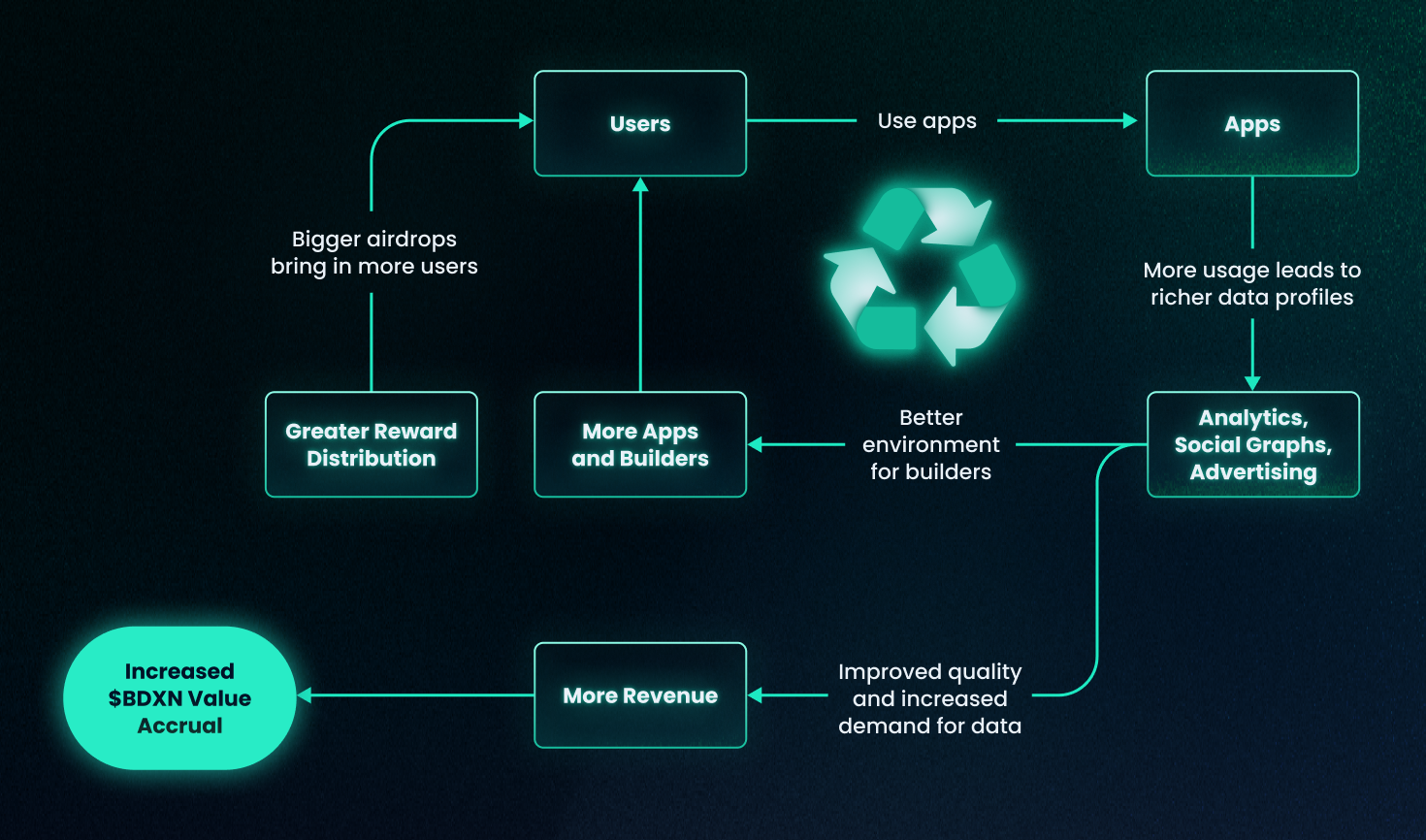
# Connect with Bondex
Stay informed, engage with our community, and explore new opportunities:
**Website**: [bondex.app](https://bondex.app) — Learn more about our mission, products, and ecosystem.
**App**: Download the Bondex app on [iOS](https://apps.apple.com/) and [Android](https://play.google.com/) to build your digital identity and grow your network.
**Jobs Portal**: Discover talent or your next role at [bondex.com](https://bondex.app/job-portal).
**Social Media:**
* X (Twitter): [@bondexapp](https://twitter.com/bondexapp) — Join conversations on onchain identity and the future of work.
* LinkedIn: [Bondex](https://linkedin.com/company/bondex) — Follow updates on partnerships and professional growth.
* Telegram: [Bondex Community](https://t.me/BondexAnnouncements) — Chat with fellow users and get real-time support.
* Discord: [Bondex Network](https://discord.gg/bondex) — Connect with developers and explore our ecosystem.
Support: For inquiries or assistance, contact our team at .
\
Build trust. Grow your network. Own your future.
# Bondex ID & Reputation
#### **What is Bondex ID?**
Bondex ID is an on-chain identity system designed to establish trust and transparency within the Bondex network. It serves as a unified, verifiable digital identity for users, reflecting their achievements, activities, and reputation across both Web2 and Web3 environments.
#### **What is the Reputation System?**
The Bondex Reputation System measures a user’s credibility, expertise, and activity within the Bondex network. Reputation is determined by points earned through verifications across four categories: Identity, Professional, Blockchain & Crypto, and Social. The total Reputation score places users into one of three levels:
* **Contributor (0-24 points)**
* This entry-level status indicates that a user has begun participating in the Bondex ecosystem but has not yet completed significant verifications
* **Trusted** **(25-64 points)**
* Achieving this status signifies that a user has completed multiple verifications across various categories, such as Identity, Professional, Blockchain & Crypto, and Social.
* **Elite** **(65+ points)**
* Elite users have a fully verified identity and a comprehensive set of credentials, granting them the highest level of platform benefits and the most advantageous Activity Rates for earning Bond Points.
Achieving **Trusted** and **Elite** levels demonstrates a user's verified identity, as well as achievements and credentials across the other categories. These levels unlock enhanced benefits on the platform, including higher Activity Rates for earning Bond Points.
# Reputation Level Benefits
### **Why is the Reputation System Important?**
The Reputation score and level are visible on user profiles, reinforcing trust and credibility. As the platform evolves, users with high reputation levels will stand out as trusted participants in the Web3 talent network.
### **Benefits of Achieving Trusted and Elite Levels**
Achieving Trusted (25+ points) or Elite (65+ points) status within the Bondex network unlocks key benefits for users:
**Increased Activity Rate**\
Users at Trusted or Elite levels earn Bond Points at a higher hourly rate when they activate the Boost feature. This boost lasts for 24 hours, increasing earning potential for engaged users.
**Visibility & Social Recognition**\
Reputation levels are displayed on user profiles, providing social proof of trustworthiness, experience, and engagement. This visibility is critical as Bondex develops public profiles and social networking.
**Enhanced Platform Privileges**\
As the platform grows, high-reputation users may gain access to exclusive features, premium job listings, or early access to new features and products.
***
###
# Minting Your Bondex ID
Users can mint their Bondex ID once they achieve the **Trusted** or **Elite** reputation levels. For a limited time, this will be a **free mint**, allowing users to attest their Bondex ID and Reputation Score on-chain via the **Ethereum Attestation Service (EAS) on base**.
#### **How to Mint Your Bondex ID**
1. **Achieve Trusted or Elite Level**: Users must accumulate a minimum of 25 Reputation Points to become Trusted or 65+ points to become Elite.
2. **Initiate the Minting Process**: Once eligible, users will have an option to mint their Bondex ID within the Bondex app.
3. **On-Chain ID**: The Bondex ID and the current Reputation Score are attested on-chain using the Ethereum Attestation Service (EAS) on base, making it verifiable across the Bondex ecosystem.
#### **Updating Your Bondex ID**
If you complete additional verifications after minting, you can mint a **new Bondex ID** that reflects your updated Reputation Score. This ensures your on-chain credentials stay accurate and up-to-date.
#### **Benefits of a Minted Bondex ID**
* **Verifiable Identity**: dApps in the Bondex ecosystem can verify your on-chain Reputation Score and credentials.
* **Proof of Credibility**: Showcase your achievements, verifications, and trustworthiness across Web2 and Web3.
* **Portable Reputation**: Your on-chain Bondex ID can be recognized by other platforms and dApps in the future, increasing its utility.
**On Chain Bondex ID**
Schema: [BONDEX ID](https://base.easscan.org/schema/view/0xcbddc68392f790083c6f2e1f089489b13fad3fdfde9ccad0704e79671e0208c3)
# Reputation Score
### **How Reputation Points Are Earned**
Users can accumulate reputation points by completing specific verifications across the following categories - **Identity, Professional, Blockchain & Crypto and Social Verifications**. Each successful verification increases the user's reputation score, helping them achieve higher levels (Trusted, Elite) and unlocking additional platform benefits.
Once verified, each provider verification is written into an off-chain attestation linked to the user's primary wallet.
# Identity Verifications
Verifications that prove a user’s identity and confirm they are a real, unique individual.
* **Didit**: 15 Reputation points
* **Coinbase**: 15 Reputation points
* **Binance**: 15 Reputation points
* **Gitcoin Passport**: 10 Reputation points
# Didit
[Didit](https://didit.me/) is a leading identity verification provider that facilitates Know Your Customer (KYC) checks. It enables users to prove their identity by verifying official documents such as passports, driver's licenses, and proof of personhood.
With coverage in over 220+ countries and territories, Didit ensures a global standard for identity verification, allowing Bondex users to build a trusted on-chain identity and enhance their Reputation score.
Didit verifications are typically approved instantly. If your verification status changes to "In Review," it means manual approval by the Bondex team is required. Users can check the status later and tap "Verify" to refresh and update the progress of their identity verification.
### Verification Declined?
If your verification has been declined, please upload your documents again. When doing so, ensure the following:
* Your full name is clearly visible.
* Your date of birth is legible.
* The issue and expiration dates of the document are clear.
* Your photograph in the document is clearly visible.
* The images are sharp, well-lit, and not blurry or dark.
* Double-check that the document photo matches your uploaded photo. Verification may be declined if there’s a lack of similarity between the two.
Please ensure that the photo in the document is clear and not blurry, as the system requires a clear image for facial recognition to function properly. We recommend using a document with an updated, high-quality photo to avoid any issues with the verification process.
Make sure the documents meet these criteria to avoid further delays.
**Score:**
15 Reputation points
**Attestation:**
Schema: [BONDEX VERIFICATIONS](https://base.easscan.org/schema/view/0xf3ff6dd4a9dab34450af4e60df1eb41ca1e60fd719ce8645bbbed68aa84b489f)
Verification\_type: didit
Context: KYC Complete
# Coinbase
Complete your identity verification (KYC) and verify your Coinbase account.
Step 1: [**Verify Coinbase ID**](https://www.coinbase.com/onchain-verify) on any Bondex connected wallet.
Step 2: Ensure you have an active Coinbase account and mint your onchain attestation free on base.
Step 3: Tap 'Verify' to receive your verification on Bondex.
**Score:**
15 Reputation points
**Attestation:**
Schema: [BONDEX VERIFICATIONS](https://base.easscan.org/schema/view/0xf3ff6dd4a9dab34450af4e60df1eb41ca1e60fd719ce8645bbbed68aa84b489f)
Verification\_type: Coinbase
Context: Verified Account
# Binance
Verify by obtaining your Binance Account Bound Token (BABT) that proves you have completed identity verification.
**Step 1**: Get your [BABT](https://www.binance.com/en-GB/babt) through Binance and use your Bondex connected wallet.
Once verified, you should recieve a message on the Binance website like:
Your BAB token has been issued to \[your wallet address] on BNB Smart Chain
**Step 2**: Tap 'Verify' in the Bondex App to receive your verification. Ensure the same wallet that is connected to your Bondex Account holds your BABT token.
**Score:**
15 Reputation points
**Attestation:**
Schema: [BONDEX VERIFICATIONS](https://base.easscan.org/schema/view/0xf3ff6dd4a9dab34450af4e60df1eb41ca1e60fd719ce8645bbbed68aa84b489f)
Verification\_type: Binance
Context: BABT Verified
# Gitcoin Passport
Verify your Gitcoin Passport and earn this credential if your Humanity Score score is 15 or higher.
Step 1: Ensure the same wallet used on [Gitcoin Passport](https://passport.gitcoin.co/) is connected to your Bondex account
Step 2: Click 'Verify' to receive your verification on Bondex.
**Score:**
10 Reputation points
**Attestation:**
Schema: [BONDEX VERIFICATIONS](https://base.easscan.org/schema/view/0xf3ff6dd4a9dab34450af4e60df1eb41ca1e60fd719ce8645bbbed68aa84b489f)
Verification\_type: gitcoin\_passport
Context: Verified Passport
# Professional Verifications
Verifications that prove a user’s Verifications that highlight a user’s skills, work experience, and technical expertise.
* **Valid Resume**: 5 Reputation points
* **Github**: Up to 10 Reputation points
* **LinkedIn**: Up to 5 Reputation points
# Valid Resume
Upload a valid resume to your Bondex profile to increase your Reputation score.
Resume's should match your profile name, be written in English and include experience and education sections.
**Score:**
5 Reputation points
**Attestation:**
Schema: [BONDEX VERIFICATIONS](https://base.easscan.org/schema/view/0xf3ff6dd4a9dab34450af4e60df1eb41ca1e60fd719ce8645bbbed68aa84b489f)
Verification\_type: bdx\_resume
Context: Verified Resume
# Github
Connect your Github account through our Reclaim Verifier and receive Reputation points for qualifying verifications.
Our Github verification uses Reclaim Protocol, you can find more information [here](/bondex-id-and-reputation/bondex-id-and-reputation/reputation-score/reclaim-protocol)
**Score:**
Up to 10 Reputation points
* Verified Account (1 point)
* Github OG (2 points) - Account created before Jan 2016
* Github Contributor (4 points) - More than 500 contributions in the last year
* Github Respected (3 points) - More than 1,000 followers
**Attestation:**
Schema: [BONDEX VERIFICATIONS](https://base.easscan.org/schema/view/0xf3ff6dd4a9dab34450af4e60df1eb41ca1e60fd719ce8645bbbed68aa84b489f)
Verification\_type: github
Context:
Verified Account
Github OG
Github Contributor
Github Respected
# LinkedIn
Connect your Github account through our Reclaim Verifier and receive Reputation points for qualifying verifications.
Our LinkedIn verification uses Reclaim Protocol, you can find more information [here](/bondex-id-and-reputation/bondex-id-and-reputation/reputation-score/reclaim-protocol)
**Score:**
Up to 5 Reputation points
* Verified Account (1 point)
* LinkedIn Power Networker (2 points) - More than 500 connections
* LinkedIn Thought Leader (2 points) - More than 3,000 followers
**Attestation:**
Schema: [BONDEX VERIFICATIONS](https://base.easscan.org/schema/view/0xf3ff6dd4a9dab34450af4e60df1eb41ca1e60fd719ce8645bbbed68aa84b489f)
Verification\_type: linkedin
Context:
Verified Account
LinkedIn Power Networker
LinkedIn Thought Leader
# Blockchain & Crypto Verifications
Verifications that showcase a user’s activity and involvement within the crypto space.
* **Valid Resume**: 5 Reputation points
* **Github**: Up to 10 Reputation points
* **LinkedIn**: Up to 5 Reputation points
# Wallet Activity
Wallet activity will be aggregated across all your connected wallets.
**Score:**
Up to 13 Reputation points
* Crypto Enthusiast (3 points) - Completed over 100 transactions
* Digital Art Collector (3 points) - Collect over 30 NFTs
* Crypto OG (3 points) - First wallet transaction before Jan 2019
* Token Swapper (2 points) - Over 20 token swaps on DEXs and wallets
* Participation Bunny (2 points) - Earned 10 or more POAPs
**Attestation:**
Schema: [BONDEX VERIFICATIONS](https://base.easscan.org/schema/view/0xf3ff6dd4a9dab34450af4e60df1eb41ca1e60fd719ce8645bbbed68aa84b489f)
Verification\_type: wallet\_activity
Context:
Crypto Enthusiast
Digital Art Collector
Crypto OG
Token Swapper
Participation Bunny
# ENS
Hold an ENS linked to any of your connected wallets to receive this verification.
**Score:**
2 Reputation points
**Attestation:**
Schema: [BONDEX VERIFICATIONS](https://base.easscan.org/schema/view/0xf3ff6dd4a9dab34450af4e60df1eb41ca1e60fd719ce8645bbbed68aa84b489f)
Verification\_type: ens
Context: Verified ENS holder
# Social Verifications
Verifications that Verifications that reflect the user’s online social presence and influence.
* **X**: Up to 11 Reputation points
* **Discord**: 3 Reputation points
* **Telegram**: 3 Reputation points
* **Farcaster**: Up to 6 Reputation points
# X (Twitter)
Connect your X account through our Reclaim Verifier and receive Reputation points for qualifying verifications.
Our X verification uses Reclaim Protocol, you can find more information [here](/bondex-id-and-reputation/bondex-id-and-reputation/reputation-score/reclaim-protocol)
**Score:**
Up to 11 Reputation points
* Verified X Account (1 points)
* X OG (2 points) - Account created before Jan 2016
* X Rising Voice (2 points) - Over 1,000 followers
* X Creator (3 points) - Over 10,000 followers
* X Influencer (3 points) - Over 50,000 followers
**Attestation:**
Schema: [BONDEX VERIFICATIONS](https://base.easscan.org/schema/view/0xf3ff6dd4a9dab34450af4e60df1eb41ca1e60fd719ce8645bbbed68aa84b489f)
Verification\_type: twitter
Context:
Verified Account
X OG
X Rising Voice
X Creator
X Influencer
# Discord
Connect your Discord to receive this verification.
**Score:**
3 Reputation points
**Attestation:**
Schema: [BONDEX VERIFICATIONS](https://base.easscan.org/schema/view/0xf3ff6dd4a9dab34450af4e60df1eb41ca1e60fd719ce8645bbbed68aa84b489f)
Verification\_type: discord
Context: Verified Account
# Telegram
Connect your Telegram to receive this verification.
**Score:**
3 Reputation points
**Attestation:**
Schema: [BONDEX VERIFICATIONS](https://base.easscan.org/schema/view/0xf3ff6dd4a9dab34450af4e60df1eb41ca1e60fd719ce8645bbbed68aa84b489f)
Verification\_type: telegram
Context: Verified Account
# Farcaster
Connect your Farcaster to receive Reputation points for qualifying verifications.
**Score:**
Up to 6 Reputation points
* Verified Account (3 points) - Connected Farcaster Account
* Farcaster OG (3 points) - FID below 50,000
**Attestation:**
Schema: [BONDEX VERIFICATIONS](https://base.easscan.org/schema/view/0xf3ff6dd4a9dab34450af4e60df1eb41ca1e60fd719ce8645bbbed68aa84b489f)
Verification\_type: farcaster
Context:
Verified Account
Farcaster OG
# Reclaim Protocol
At Bondex, we leverage **Reclaim Protocol** to provide a secure, seamless, and private way for users to verify credentials from platforms like X (formerly Twitter), LinkedIn, and GitHub. These verifications contribute to your **Reputation score** on Bondex without compromising your privacy or security.
**How It Works**
Reclaim Protocol uses **zero-knowledge proof technology** to verify your credentials from these platforms. Here's what makes it secure and user-friendly:
* **Privacy First**: Neither Reclaim nor Bondex store your login details. Only the specific verification data required to update your Reputation score is securely shared.
* **Secure Process**: When verifying a provider, a secure window opens for you to log in. Reclaim automatically navigates and retrieves the necessary credentials using **client-side digital signatures**. This ensures your data remains private and secure throughout the process.
* **Effortless Experience**: The process is quick and seamless, integrating smoothly into the Bondex platform while maintaining the highest security standards.
By utilizing Reclaim Protocol, Bondex ensures that your verifications are not only secure but also aligned with our mission to create a trusted and transparent Web3 talent network.
{% embed url="" %}
# API Overview
The [Web3.career API](https://web3.career/web3-jobs-api) provides programmatic access to one of the largest aggregated databases of Web3, blockchain, and cryptocurrency job listings. It serves as a single endpoint that returns structured job data with powerful filtering capabilities.
### What the API Can Do
* **Search Web3 job listings** across hundreds of companies in the blockchain/crypto space
* **Filter by technology** — target specific languages (Solidity, Rust, TypeScript), frameworks (React, Hardhat), or ecosystems (Ethereum, Solana, Polkadot)
* **Filter by role type** — engineering, marketing, design, research, product, community, legal, finance, and more
* **Filter by geography** — search by country using slug-based identifiers
* **Filter for remote positions** — isolate fully remote roles
* **Control response size** — retrieve between 1 and 100 listings per request
* **Toggle descriptions** — include or exclude full job descriptions to control payload size
### Key Characteristics
| Property | Detail |
| ----------------- | ------------------------------------------ |
| **Base URL** | `https://web3.career/api/v1` |
| **Protocol** | HTTPS only |
| **Method** | `GET` |
| **Auth** | API token as query parameter |
| **Formats** | JSON (`.../v1`) and RSS XML (`.../v1.xml`) |
| **Rate Limiting** | Yes (429 responses when exceeded) |
| **Max Results** | 100 per request |
| **Pagination** | Via `limit` parameter (no cursor/offset) |
### Getting an API Token
1. Visit
2. Sign up or log in to your account
3. Generate your API token
4. Store it securely — treat it like a password
### Quick Example
```bash
# Fetch 5 remote Solidity jobs (JSON)
curl "https://web3.career/api/v1?token=YOUR_TOKEN&tag=solidity&remote=true&limit=5"
# Same query as RSS XML
curl "https://web3.career/api/v1.xml?token=YOUR_TOKEN&tag=solidity&remote=true&limit=5"
```
### Terms of Use
The API has mandatory requirements that must be followed to maintain access:
1. **Link attribution is required.** When displaying jobs, you must link to the job using the `apply_url` field with a **follow link** (`rel="follow"` or no `rel` attribute). Do **not** use `rel="nofollow"`. Failure to provide follow links back to web3.career will result in API access suspension.
2. **Do not modify `apply_url`.** Do not append tracking parameters (e.g., `utm_source`, `utm_medium`, `ref`) to the URL. Required tracking parameters are already embedded in the URL by web3.career.
3. **Keep your token private.** Your token is for your use only. Do not share it, commit it to version control, or expose it in client-side code.
### Documentation Index
| Document | Description |
| ----------------------------------------------------------------------------------------------------------------------------------- | --------------------------------------------------------------------------------------- |
| [API Reference](https://file+.vscode-resource.vscode-cdn.net/Users/paulmartin/Github/Web3-career-mcp/docs/API-Reference.md) | Complete endpoint specification, parameters, response format, and field definitions |
| [Filtering Guide](https://file+.vscode-resource.vscode-cdn.net/Users/paulmartin/Github/Web3-career-mcp/docs/API-Filtering-Guide.md) | Deep dive into tags, countries, combining filters, and practical search strategies |
| [Best Practices](https://file+.vscode-resource.vscode-cdn.net/Users/paulmartin/Github/Web3-career-mcp/docs/API-Best-Practices.md) | Rate limiting, caching, error handling, response parsing, and production tips |
| [OpenAPI Spec](https://file+.vscode-resource.vscode-cdn.net/Users/paulmartin/Github/Web3-career-mcp/docs/openapi.yaml) | Machine-readable OpenAPI 3.1 specification for code generation, Swagger UI, and tooling |
# API Reference
Practical guidance for working with the API in production
***
### 1. Parsing the Response Correctly
This is the most critical thing to get right. The API response is **not** a simple array of job objects.
#### The Problem
The API returns a top-level JSON array that contains **mixed types** — typically two strings followed by the actual jobs array:
```json
["string_value", "another_string", [{ "title": "...", ... }, { "title": "...", ... }]]
```
If you naively treat the response as `Job[]`, you'll get strings instead of job objects.
#### The Solution
Search for the nested array within the root array:
```javascript
const response = await fetch(url);
const data = await response.json();
if (!Array.isArray(data)) {
throw new Error('Unexpected response format');
}
// Find the nested array containing job objects
let jobs = data.find(item => Array.isArray(item));
// Fallback: if every element is an object, the root array IS the jobs array
if (!jobs && data.length > 0 && typeof data[0] === 'object' && data[0] !== null) {
jobs = data;
}
if (!jobs || !Array.isArray(jobs)) {
throw new Error('Could not locate jobs array in response');
}
```
#### Python Equivalent
```python
import requests
resp = requests.get(url, params=params)
data = resp.json()
if not isinstance(data, list):
raise ValueError("Unexpected response format")
jobs = next((item for item in data if isinstance(item, list)), None)
if jobs is None and len(data) > 0 and isinstance(data[0], dict):
jobs = data
if not jobs:
raise ValueError("Could not locate jobs array in response")
```
> **Do not assume the response structure is stable.** The mixed-type root array is the current behaviour, but defensive parsing that searches for the jobs array will survive format changes.
***
### 2. Handling HTML in Descriptions
Job descriptions frequently contain raw HTML markup:
```html
We are looking for a Senior Solidity Developer to join our team.
5+ years of experience
Knowledge of ERC-20 and ERC-721 standards
```
#### Strip HTML for Plain Text
```javascript
function stripHtml(html) {
return html
.replace(/<[^>]+>/g, ' ') // Replace tags with spaces
.replace(/\s+/g, ' ') // Collapse whitespace
.trim();
}
```
#### Truncate Long Descriptions
Descriptions can be very long. If you're displaying summaries or working within token limits (e.g., AI/LLM contexts), truncate after stripping:
```javascript
function cleanDescription(html, maxLength = 500) {
const text = stripHtml(html);
if (text.length > maxLength) {
return text.substring(0, maxLength) + '...';
}
return text;
}
```
#### When to Disable Descriptions
Use `show_description=false` when:
* Building a job listing/browse view (titles + companies are enough)
* Doing an initial scan before fetching details
* Working within bandwidth or payload size constraints
* The consumer doesn't need description text (e.g., job count analytics)
***
### 3. Caching
The API returns recent job listings that don't change by the second. Caching responses for **5 minutes** is a sensible default — it reduces API calls significantly while keeping data fresh enough for most use cases.
#### Simple In-Memory Cache
```javascript
class Cache {
constructor(ttlMs = 5 * 60 * 1000) {
this.store = new Map();
this.ttl = ttlMs;
}
get(key) {
const entry = this.store.get(key);
if (!entry) return undefined;
if (Date.now() > entry.expiry) {
this.store.delete(key);
return undefined;
}
return entry.value;
}
set(key, value) {
this.store.set(key, { value, expiry: Date.now() + this.ttl });
}
}
```
#### Cache Key Strategy
Use the full set of filter parameters as the cache key. Serialise them deterministically:
```javascript
const cacheKey = JSON.stringify({ tag, country, remote, limit, show_description });
```
This ensures that `?tag=solidity&limit=10` and `?tag=solidity&limit=20` are cached separately.
#### When to Cache More Aggressively
* **Static reference data** (like the list of available tags) can be cached indefinitely or for hours
* **Broad, unfiltered queries** are expensive and change slowly — cache for 10+ minutes
* **Highly specific queries** (tag + country + remote) return smaller datasets that change more often — 5 minutes is appropriate
***
### 4. Rate Limiting and Retry Logic
The API enforces rate limits and returns `429 Too Many Requests` when exceeded.
#### Exponential Backoff with Jitter
```javascript
async function fetchWithRetry(url, params, maxRetries = 3) {
for (let attempt = 0; attempt <= maxRetries; attempt++) {
try {
const response = await fetch(url + '?' + new URLSearchParams(params));
if (response.ok) return response;
if (response.status === 429 || response.status >= 500) {
if (attempt === maxRetries) throw new Error(`Failed after ${maxRetries} retries`);
const baseDelay = Math.min(1000 * Math.pow(2, attempt), 10000);
const jitter = baseDelay * 0.2 * (Math.random() * 2 - 1); // +/- 20%
await new Promise(r => setTimeout(r, baseDelay + jitter));
continue;
}
throw new Error(`API error: ${response.status}`);
} catch (err) {
if (attempt === maxRetries) throw err;
// Retry on network errors too
const delay = Math.min(1000 * Math.pow(2, attempt), 10000);
await new Promise(r => setTimeout(r, delay));
}
}
}
```
#### What to Retry
| Error | Retry? | Why |
| ----------------------------- | ------- | --------------------------------- |
| `429 Too Many Requests` | **Yes** | Temporary rate limit — will clear |
| `5xx Server Error` | **Yes** | Transient server issues |
| Network timeout / no response | **Yes** | Connectivity blip |
| `401 Unauthorized` | **No** | Bad token — retrying won't help |
| `403 Forbidden` | **No** | Permissions issue |
| `4xx` (other) | **No** | Client error — fix the request |
#### Recommended Retry Config
| Setting | Value | Rationale |
| ------------- | ---------- | ----------------------------------------------------------------- |
| Max retries | 3 | Enough to ride out transient issues without hammering the API |
| Initial delay | 1 second | Gives the rate limiter time to reset |
| Max delay | 10 seconds | Caps wait time to keep UX responsive |
| Jitter | +/- 20% | Prevents thundering herd if multiple clients retry simultaneously |
***
### 5. Input Validation
The API silently returns empty results for invalid filter values. Validate on the client side to catch mistakes early.
#### Validate Tags
```javascript
const VALID_TAGS = [
"ai", "analyst", "backend", "bitcoin", "blockchain", "community-manager",
"crypto", "cryptography", "cto", "customer-support", "dao", "data-science",
"defi", "design", "developer-relations", "devops", "discord", "economy-designer",
"entry-level", "erc", "erc-20", "evm", "front-end", "full-stack", "gaming",
"ganache", "golang", "hardhat", "intern", "java", "javascript", "layer-2",
"marketing", "mobile", "moderator", "nft", "node", "non-tech", "open-source",
"openzeppelin", "pay-in-crypto", "product-manager", "project-manager",
"react", "refi", "research", "ruby", "rust", "sales", "smart-contract",
"solana", "solidity", "truffle", "web3-py", "web3js", "zero-knowledge"
];
function isValidTag(tag) {
return VALID_TAGS.includes(tag.toLowerCase());
}
```
#### Validate Country Slugs
```javascript
function isValidCountrySlug(slug) {
// Must be lowercase, may contain hyphens, no spaces or special chars
return /^[a-z]+(-[a-z]+)*$/.test(slug);
}
```
#### Common Mistakes to Catch
| User Input | Problem | Correct Value |
| ------------------- | ----------------- | ------------------ |
| `"Solidity"` | Capitalised | `"solidity"` |
| `"react developer"` | Multi-word phrase | `"react"` |
| `"web3 marketing"` | Multi-word phrase | `"marketing"` |
| `"USA"` | Not a slug | `"united-states"` |
| `"UK"` | Not a slug | `"united-kingdom"` |
| `"solidty"` | Typo | `"solidity"` |
***
### 6. Handling Optional Fields
Job objects have inconsistent field presence. Not every job has every field. Always code defensively:
```javascript
// Defensive field access
const title = job.title || 'Untitled Position';
const salary = job.salary || 'Not disclosed';
const tags = Array.isArray(job.tags) ? job.tags : [];
const isRemote = job.remote === true;
```
#### Extra Fields
Job objects may contain fields beyond the documented schema. The API can return additional metadata. Use a pass-through pattern to preserve these:
```javascript
// Preserve all fields, even unexpected ones
const processed = {
id: job.id,
title: job.title,
company: job.company,
// ... known fields ...
};
// Copy any extra fields
Object.keys(job).forEach(key => {
if (!(key in processed)) {
processed[key] = job[key];
}
});
```
***
### 7. Efficient Multi-Tag Searching
Since the API only supports one tag per request, searching across multiple tags requires parallel requests.
#### Parallel Fetching with Deduplication
```javascript
async function searchMultipleTags(tags, baseFilters = {}) {
const results = await Promise.all(
tags.map(tag => fetchJobs({ ...baseFilters, tag }))
);
// Deduplicate by URL (most reliable unique identifier)
const seen = new Set();
const unique = [];
for (const jobs of results) {
for (const job of jobs) {
const key = job.url || job.id || JSON.stringify(job);
if (!seen.has(key)) {
seen.add(key);
unique.push(job);
}
}
}
return unique;
}
// Usage: find any engineering job
const engineeringJobs = await searchMultipleTags(
['backend', 'front-end', 'full-stack', 'smart-contract'],
{ remote: true, limit: 30 }
);
```
> **Be mindful of rate limits** when making parallel requests. If you're searching across many tags, consider batching with delays between groups.
***
### 8. Optimising Payload Size
Full responses with descriptions can be large. Optimise based on your use case:
| Scenario | `show_description` | `limit` | Why |
| -------------------- | ------------------ | ------- | -------------------------------------------------- |
| Job listing page | `false` | 50-100 | Titles + companies are enough for browsing |
| Job detail view | `true` | 1-5 | Only fetch descriptions for jobs the user selected |
| AI agent summary | `true` | 10-20 | AI needs descriptions for context, but limit count |
| Analytics / counting | `false` | 100 | Maximise data, minimise bandwidth |
| Alert / notification | `false` | 10 | Quick check for new postings |
***
### 9. Error Handling Checklist
A robust integration should handle all of these:
* \[ ] **401** — Token is wrong or expired. Surface a clear message pointing to the token page.
* \[ ] **403** — Token permissions issue. Direct user to check their account.
* \[ ] **429** — Rate limit. Implement backoff + retry. Surface a "please wait" message if retry fails.
* \[ ] **5xx** — Server down. Retry with backoff. Show cached data if available.
* \[ ] **Network error** — No response received. Retry, then surface connectivity message.
* \[ ] **Empty results** — Not an error, but possibly an invalid filter. Suggest checking tag/country spelling.
* \[ ] **Unexpected response format** — The response shape changed. Log the raw response for debugging.
* \[ ] **Missing fields on jobs** — Gracefully handle `undefined` for any field.
* \[ ] **HTML in descriptions** — Strip or render depending on context.
***
### 10. Link Attribution (Mandatory)
Compliance with the link-back requirement is **mandatory** — failure will result in API access suspension.
#### Rules
1. Always link to jobs using the `apply_url` field
2. Links must be **follow links** (`rel="follow"` or no `rel` attribute)
3. Never add `rel="nofollow"`, `rel="ugc"`, or `rel="sponsored"`
4. Never append tracking parameters (`utm_source`, `utm_medium`, `ref`, etc.) — they're already in the URL
#### Implementation
```html
ApplyApplyApplyApply
```
#### Framework-Specific Notes
**React / Next.js:**
```jsx
// Next.js defaults to no rel attribute — this is fine
{job.title}
// Or with explicit follow
{job.title}
```
**Server-rendered HTML:**
```html
{{title}} at {{company}}
```
#### For MCP / AI Agent Use Cases
When returning job data through an MCP server or AI agent (where there's no HTML rendering), always include the `apply_url` in the response so downstream consumers can link correctly. Include a note that the URL must not be modified.
***
### 11. Using the RSS XML Endpoint
The API also supports RSS XML responses at a parallel endpoint:
```
GET https://web3.career/api/v1.xml?token=YOUR_TOKEN
```
This accepts the same query parameters as the JSON endpoint and returns standard RSS XML. Use cases:
* **Feed readers** — subscribe to specific job searches (e.g., `?tag=solidity&remote=true`)
* **Zapier / IFTTT / n8n** — trigger automations when new jobs match your filters
* **Email digests** — pipe the RSS feed into a digest tool for daily/weekly summaries
* **Slack/Discord bots** — RSS-to-channel integrations for team job alerts
```bash
# RSS feed for remote Rust jobs
curl "https://web3.career/api/v1.xml?token=YOUR_TOKEN&tag=rust&remote=true"
```
***
### 12. Security Considerations
* **Never commit your API token** to version control. Use environment variables.
* **Never log the full request URL** in production — it contains your token as a query parameter.
* **Add `.env` and `.env.local` to `.gitignore`** if storing tokens in env files.
* **Rotate tokens** if you suspect they've been exposed (check web3.career account settings).
* **Your token is for your use only.** Do not share it with others or use it across multiple unrelated projects/services.
* If building a multi-user service, **never share tokens between users** — each user should authenticate with their own token.
# API Filtering Guide
The API supports filtering by tag, country, and remote status. These filters can be combined to build highly targeted job searches. This guide covers every available filter value and strategies for getting the most out of them.
***
### Tag Filtering
The `tag` parameter is the most powerful filter. It accepts a **single** slug per request — you cannot combine multiple tags in one call.
#### How Tags Work
* Tags are exact-match slugs: `"solidity"` works, `"Solidity"` or `"solidity developer"` does not
* One tag per request — to search across multiple tags, make separate API calls
* Invalid tags return empty results with no error, so always validate against the known list
* Tags cover roles, technologies, languages, ecosystems, and Web3-specific concepts
#### Complete Tag Reference
**Roles & Seniority**
| Tag | What It Returns |
| --------------------- | --------------------------------------------------------- |
| `analyst` | Data analysts, business analysts, research analysts |
| `community-manager` | Community managers, community leads |
| `cto` | CTO and senior technical leadership positions |
| `customer-support` | Support engineers, customer success roles |
| `data-science` | Data scientists, ML engineers in Web3 |
| `design` | UI/UX designers, product designers, graphic designers |
| `developer-relations` | DevRel, developer advocates, ecosystem leads |
| `devops` | DevOps engineers, SRE, infrastructure roles |
| `economy-designer` | Tokenomics designers, game economy architects |
| `entry-level` | Junior roles, associate positions, no experience required |
| `intern` | Internship positions |
| `marketing` | Marketing managers, growth leads, content marketers |
| `moderator` | Discord/community moderators |
| `non-tech` | Non-technical roles across all categories |
| `product-manager` | Product managers, product owners |
| `project-manager` | Project managers, program managers |
| `research` | Researchers — cryptography, protocol, market research |
| `sales` | Sales representatives, business development |
**Engineering Disciplines**
| Tag | What It Returns |
| ---------------- | ---------------------------------------------------- |
| `backend` | Backend engineers, API developers, server-side roles |
| `front-end` | Frontend engineers, UI developers |
| `full-stack` | Full-stack developers |
| `mobile` | iOS, Android, React Native developers |
| `smart-contract` | Smart contract developers, auditors |
| `cryptography` | Cryptographers, zero-knowledge engineers |
| `gaming` | Game developers, metaverse engineers |
| `security` | Security engineers, auditors, pen testers |
**Languages & Frameworks**
| Tag | What It Returns |
| ------------ | ------------------------------------------------------ |
| `golang` | Go/Golang developer positions |
| `java` | Java developer positions |
| `javascript` | JavaScript developer positions |
| `node` | Node.js backend positions |
| `python` | Python developer positions |
| `react` | React/React Native frontend positions |
| `ruby` | Ruby developer positions |
| `rust` | Rust developer positions (very common in Web3) |
| `solidity` | Solidity smart contract positions (Ethereum ecosystem) |
| `typescript` | TypeScript developer positions |
| `web3js` | Positions requiring Web3.js library experience |
| `web3-py` | Positions requiring Web3.py (Python) experience |
**Blockchain Ecosystems**
| Tag | What It Returns |
| ------------ | ------------------------------------------------------- |
| `bitcoin` | Bitcoin-focused roles (Lightning, Ordinals, mining) |
| `blockchain` | General blockchain roles (not ecosystem-specific) |
| `ethereum` | Ethereum ecosystem roles |
| `evm` | EVM-compatible chain roles (broader than just Ethereum) |
| `solana` | Solana ecosystem roles |
| `polkadot` | Polkadot/Substrate ecosystem roles |
| `layer-2` | L2 scaling solutions (Arbitrum, Optimism, zkSync, etc.) |
**Web3-Specific Concepts**
| Tag | What It Returns |
| ---------------- | --------------------------------------------------------- |
| `ai` | AI/ML roles within Web3 companies |
| `crypto` | General cryptocurrency roles |
| `dao` | DAO governance, operations, tooling roles |
| `defi` | Decentralised finance roles (protocols, yield, lending) |
| `discord` | Discord-focused roles (bot dev, community) |
| `erc` | ERC standard-related development |
| `erc-20` | ERC-20 token-specific roles |
| `ganache` | Roles requiring Ganache (Truffle suite) |
| `hardhat` | Roles requiring Hardhat development framework |
| `nft` | NFT-related roles (marketplaces, collections, tooling) |
| `open-source` | Open-source focused positions |
| `openzeppelin` | Roles requiring OpenZeppelin library knowledge |
| `pay-in-crypto` | Positions that offer cryptocurrency compensation |
| `refi` | Regenerative finance roles |
| `truffle` | Roles requiring Truffle development framework |
| `zero-knowledge` | Zero-knowledge proof roles (zkSNARKs, zkSTARKs, circuits) |
***
### Country Filtering
The `country` parameter uses **lowercase, hyphenated slugs** — not country names, ISO codes, or abbreviations.
#### Format Rules
| Input | Valid? | Notes |
| ---------------- | ------ | ---------------------------------------- |
| `united-states` | Yes | Correct slug format |
| `United States` | **No** | Must be lowercase and hyphenated |
| `USA` | **No** | ISO codes not supported |
| `us` | **No** | Two-letter codes not supported |
| `germany` | Yes | Single-word countries are just lowercase |
| `united-kingdom` | Yes | Multi-word countries use hyphens |
#### Common Country Slugs
```
united-states
united-kingdom
germany
france
singapore
canada
australia
switzerland
netherlands
portugal
spain
india
japan
brazil
dubai
hong-kong
south-korea
```
> **Tip:** If you're unsure of the exact slug for a country, try the lowercase, hyphenated version of the English country name. Invalid slugs return empty results — they won't cause errors.
***
### Remote Filtering
The `remote` parameter filters for remote-only positions.
```
# Remote jobs only
?remote=true
# All jobs (remote + on-site) — just omit the parameter
?token=YOUR_TOKEN&limit=20
```
There is no `remote=false` for on-site-only filtering. Omitting the parameter returns all positions.
***
### Combining Filters
All filters can be used together. Each additional filter narrows the results.
#### Combination Examples
```bash
# Remote Rust jobs (worldwide)
?tag=rust&remote=true
# Smart contract jobs in the United States
?tag=smart-contract&country=united-states
# Remote DeFi jobs, top 50
?tag=defi&remote=true&limit=50
# Entry-level remote positions, no descriptions (fast payload)
?tag=entry-level&remote=true&show_description=false
# Zero-knowledge roles in Switzerland
?tag=zero-knowledge&country=switzerland
```
#### Filter Interaction
* **tag + country**: Returns jobs matching the tag AND located in that country
* **tag + remote**: Returns jobs matching the tag AND flagged as remote
* **country + remote**: Returns remote jobs based in that country (some remote roles are geo-restricted)
* **All three**: Most specific — e.g., remote Solidity jobs based in the US
***
### Search Strategies
Since the API only supports one tag per request, here are practical strategies for common use cases.
#### "Find me a Solidity developer role"
Single call — the tag does the work:
```
?tag=solidity&limit=50
```
#### "Find me any engineering role"
Make parallel calls across engineering tags:
```
?tag=backend&limit=30
?tag=front-end&limit=30
?tag=full-stack&limit=30
?tag=smart-contract&limit=30
```
Deduplicate results by job `id` or `url` on the client side.
#### "What jobs pay in crypto?"
```
?tag=pay-in-crypto&limit=100
```
#### "Show me non-technical Web3 jobs"
```
?tag=non-tech&limit=50
```
Or search specific non-tech roles:
```
?tag=marketing&limit=30
?tag=sales&limit=30
?tag=community-manager&limit=30
?tag=product-manager&limit=30
```
#### "Find remote jobs in a specific ecosystem"
```
?tag=solana&remote=true&limit=50
?tag=ethereum&remote=true&limit=50
?tag=polkadot&remote=true&limit=50
```
#### "What AI roles exist in Web3?"
```
?tag=ai&limit=100
```
#### "Find me entry-level positions to break into Web3"
```
?tag=entry-level&limit=50
?tag=intern&limit=50
```
#### Reducing Response Size for Browsing
When building a listing/browse UI or doing an initial scan, disable descriptions:
```
?tag=defi&limit=100&show_description=false
```
Then fetch full details (with descriptions) only for jobs the user clicks on. This dramatically reduces payload size and response time.
# API Best Practices
Practical guidance for working with the API in production
***
### 1. Parsing the Response Correctly
This is the most critical thing to get right. The API response is **not** a simple array of job objects.
#### The Problem
The API returns a top-level JSON array that contains **mixed types** — typically two strings followed by the actual jobs array:
```json
["string_value", "another_string", [{ "title": "...", ... }, { "title": "...", ... }]]
```
If you naively treat the response as `Job[]`, you'll get strings instead of job objects.
#### The Solution
Search for the nested array within the root array:
```javascript
const response = await fetch(url);
const data = await response.json();
if (!Array.isArray(data)) {
throw new Error('Unexpected response format');
}
// Find the nested array containing job objects
let jobs = data.find(item => Array.isArray(item));
// Fallback: if every element is an object, the root array IS the jobs array
if (!jobs && data.length > 0 && typeof data[0] === 'object' && data[0] !== null) {
jobs = data;
}
if (!jobs || !Array.isArray(jobs)) {
throw new Error('Could not locate jobs array in response');
}
```
#### Python Equivalent
```python
import requests
resp = requests.get(url, params=params)
data = resp.json()
if not isinstance(data, list):
raise ValueError("Unexpected response format")
jobs = next((item for item in data if isinstance(item, list)), None)
if jobs is None and len(data) > 0 and isinstance(data[0], dict):
jobs = data
if not jobs:
raise ValueError("Could not locate jobs array in response")
```
> **Do not assume the response structure is stable.** The mixed-type root array is the current behaviour, but defensive parsing that searches for the jobs array will survive format changes.
***
### 2. Handling HTML in Descriptions
Job descriptions frequently contain raw HTML markup:
```html
We are looking for a Senior Solidity Developer to join our team.
5+ years of experience
Knowledge of ERC-20 and ERC-721 standards
```
#### Strip HTML for Plain Text
```javascript
function stripHtml(html) {
return html
.replace(/<[^>]+>/g, ' ') // Replace tags with spaces
.replace(/\s+/g, ' ') // Collapse whitespace
.trim();
}
```
#### Truncate Long Descriptions
Descriptions can be very long. If you're displaying summaries or working within token limits (e.g., AI/LLM contexts), truncate after stripping:
```javascript
function cleanDescription(html, maxLength = 500) {
const text = stripHtml(html);
if (text.length > maxLength) {
return text.substring(0, maxLength) + '...';
}
return text;
}
```
#### When to Disable Descriptions
Use `show_description=false` when:
* Building a job listing/browse view (titles + companies are enough)
* Doing an initial scan before fetching details
* Working within bandwidth or payload size constraints
* The consumer doesn't need description text (e.g., job count analytics)
***
### 3. Caching
The API returns recent job listings that don't change by the second. Caching responses for **5 minutes** is a sensible default — it reduces API calls significantly while keeping data fresh enough for most use cases.
#### Simple In-Memory Cache
```javascript
class Cache {
constructor(ttlMs = 5 * 60 * 1000) {
this.store = new Map();
this.ttl = ttlMs;
}
get(key) {
const entry = this.store.get(key);
if (!entry) return undefined;
if (Date.now() > entry.expiry) {
this.store.delete(key);
return undefined;
}
return entry.value;
}
set(key, value) {
this.store.set(key, { value, expiry: Date.now() + this.ttl });
}
}
```
#### Cache Key Strategy
Use the full set of filter parameters as the cache key. Serialise them deterministically:
```javascript
const cacheKey = JSON.stringify({ tag, country, remote, limit, show_description });
```
This ensures that `?tag=solidity&limit=10` and `?tag=solidity&limit=20` are cached separately.
#### When to Cache More Aggressively
* **Static reference data** (like the list of available tags) can be cached indefinitely or for hours
* **Broad, unfiltered queries** are expensive and change slowly — cache for 10+ minutes
* **Highly specific queries** (tag + country + remote) return smaller datasets that change more often — 5 minutes is appropriate
***
### 4. Rate Limiting and Retry Logic
The API enforces rate limits and returns `429 Too Many Requests` when exceeded.
#### Exponential Backoff with Jitter
```javascript
async function fetchWithRetry(url, params, maxRetries = 3) {
for (let attempt = 0; attempt <= maxRetries; attempt++) {
try {
const response = await fetch(url + '?' + new URLSearchParams(params));
if (response.ok) return response;
if (response.status === 429 || response.status >= 500) {
if (attempt === maxRetries) throw new Error(`Failed after ${maxRetries} retries`);
const baseDelay = Math.min(1000 * Math.pow(2, attempt), 10000);
const jitter = baseDelay * 0.2 * (Math.random() * 2 - 1); // +/- 20%
await new Promise(r => setTimeout(r, baseDelay + jitter));
continue;
}
throw new Error(`API error: ${response.status}`);
} catch (err) {
if (attempt === maxRetries) throw err;
// Retry on network errors too
const delay = Math.min(1000 * Math.pow(2, attempt), 10000);
await new Promise(r => setTimeout(r, delay));
}
}
}
```
#### What to Retry
| Error | Retry? | Why |
| ----------------------------- | ------- | --------------------------------- |
| `429 Too Many Requests` | **Yes** | Temporary rate limit — will clear |
| `5xx Server Error` | **Yes** | Transient server issues |
| Network timeout / no response | **Yes** | Connectivity blip |
| `401 Unauthorized` | **No** | Bad token — retrying won't help |
| `403 Forbidden` | **No** | Permissions issue |
| `4xx` (other) | **No** | Client error — fix the request |
#### Recommended Retry Config
| Setting | Value | Rationale |
| ------------- | ---------- | ----------------------------------------------------------------- |
| Max retries | 3 | Enough to ride out transient issues without hammering the API |
| Initial delay | 1 second | Gives the rate limiter time to reset |
| Max delay | 10 seconds | Caps wait time to keep UX responsive |
| Jitter | +/- 20% | Prevents thundering herd if multiple clients retry simultaneously |
***
### 5. Input Validation
The API silently returns empty results for invalid filter values. Validate on the client side to catch mistakes early.
#### Validate Tags
```javascript
const VALID_TAGS = [
"ai", "analyst", "backend", "bitcoin", "blockchain", "community-manager",
"crypto", "cryptography", "cto", "customer-support", "dao", "data-science",
"defi", "design", "developer-relations", "devops", "discord", "economy-designer",
"entry-level", "erc", "erc-20", "evm", "front-end", "full-stack", "gaming",
"ganache", "golang", "hardhat", "intern", "java", "javascript", "layer-2",
"marketing", "mobile", "moderator", "nft", "node", "non-tech", "open-source",
"openzeppelin", "pay-in-crypto", "product-manager", "project-manager",
"react", "refi", "research", "ruby", "rust", "sales", "smart-contract",
"solana", "solidity", "truffle", "web3-py", "web3js", "zero-knowledge"
];
function isValidTag(tag) {
return VALID_TAGS.includes(tag.toLowerCase());
}
```
#### Validate Country Slugs
```javascript
function isValidCountrySlug(slug) {
// Must be lowercase, may contain hyphens, no spaces or special chars
return /^[a-z]+(-[a-z]+)*$/.test(slug);
}
```
#### Common Mistakes to Catch
| User Input | Problem | Correct Value |
| ------------------- | ----------------- | ------------------ |
| `"Solidity"` | Capitalised | `"solidity"` |
| `"react developer"` | Multi-word phrase | `"react"` |
| `"web3 marketing"` | Multi-word phrase | `"marketing"` |
| `"USA"` | Not a slug | `"united-states"` |
| `"UK"` | Not a slug | `"united-kingdom"` |
| `"solidty"` | Typo | `"solidity"` |
***
### 6. Handling Optional Fields
Job objects have inconsistent field presence. Not every job has every field. Always code defensively:
```javascript
// Defensive field access
const title = job.title || 'Untitled Position';
const salary = job.salary || 'Not disclosed';
const tags = Array.isArray(job.tags) ? job.tags : [];
const isRemote = job.remote === true;
```
#### Extra Fields
Job objects may contain fields beyond the documented schema. The API can return additional metadata. Use a pass-through pattern to preserve these:
```javascript
// Preserve all fields, even unexpected ones
const processed = {
id: job.id,
title: job.title,
company: job.company,
// ... known fields ...
};
// Copy any extra fields
Object.keys(job).forEach(key => {
if (!(key in processed)) {
processed[key] = job[key];
}
});
```
***
### 7. Efficient Multi-Tag Searching
Since the API only supports one tag per request, searching across multiple tags requires parallel requests.
#### Parallel Fetching with Deduplication
```javascript
async function searchMultipleTags(tags, baseFilters = {}) {
const results = await Promise.all(
tags.map(tag => fetchJobs({ ...baseFilters, tag }))
);
// Deduplicate by URL (most reliable unique identifier)
const seen = new Set();
const unique = [];
for (const jobs of results) {
for (const job of jobs) {
const key = job.url || job.id || JSON.stringify(job);
if (!seen.has(key)) {
seen.add(key);
unique.push(job);
}
}
}
return unique;
}
// Usage: find any engineering job
const engineeringJobs = await searchMultipleTags(
['backend', 'front-end', 'full-stack', 'smart-contract'],
{ remote: true, limit: 30 }
);
```
> **Be mindful of rate limits** when making parallel requests. If you're searching across many tags, consider batching with delays between groups.
***
### 8. Optimising Payload Size
Full responses with descriptions can be large. Optimise based on your use case:
| Scenario | `show_description` | `limit` | Why |
| -------------------- | ------------------ | ------- | -------------------------------------------------- |
| Job listing page | `false` | 50-100 | Titles + companies are enough for browsing |
| Job detail view | `true` | 1-5 | Only fetch descriptions for jobs the user selected |
| AI agent summary | `true` | 10-20 | AI needs descriptions for context, but limit count |
| Analytics / counting | `false` | 100 | Maximise data, minimise bandwidth |
| Alert / notification | `false` | 10 | Quick check for new postings |
***
### 9. Error Handling Checklist
A robust integration should handle all of these:
* \[ ] **401** — Token is wrong or expired. Surface a clear message pointing to the token page.
* \[ ] **403** — Token permissions issue. Direct user to check their account.
* \[ ] **429** — Rate limit. Implement backoff + retry. Surface a "please wait" message if retry fails.
* \[ ] **5xx** — Server down. Retry with backoff. Show cached data if available.
* \[ ] **Network error** — No response received. Retry, then surface connectivity message.
* \[ ] **Empty results** — Not an error, but possibly an invalid filter. Suggest checking tag/country spelling.
* \[ ] **Unexpected response format** — The response shape changed. Log the raw response for debugging.
* \[ ] **Missing fields on jobs** — Gracefully handle `undefined` for any field.
* \[ ] **HTML in descriptions** — Strip or render depending on context.
***
### 10. Security Considerations
* **Never commit your API token** to version control. Use environment variables.
* **Never log the full request URL** in production — it contains your token as a query parameter.
* **Add `.env` and `.env.local` to `.gitignore`** if storing tokens in env files.
* **Rotate tokens** if you suspect they've been exposed (check web3.career account settings).
* If building a multi-user service, **never share tokens between users** — each user should authenticate with their own token.
# Authentication
All requests require an API token passed as the `token` query parameter. Obtain your token at [web3.career/web3-jobs-api](https://web3.career/web3-jobs-api).
# Important: Response Structure
The API returns a **top-level JSON array containing mixed types**. The actual jobs array is **nested inside** the root array — typically at index 2. You must search the root array for the first element that is itself an array to extract job objects.
```json
["string_value", "another_string", [{ "title": "..." }, { "title": "..." }]]
```
See the response schema for details.
# RSS XML Endpoint
An RSS XML variant is available at `/v1.xml` with the same parameters. Useful for feed readers, automation tools (Zapier, n8n), and syndication.
# Silent Filter Failures
Invalid `tag` or `country` values do **not** produce errors. The API returns a valid 200 response with zero matching jobs. Always validate filter inputs on the client side.
# Terms of Use — Mandatory Link Attribution
When displaying jobs from this API, you **must**:
* Link to jobs using the `apply_url` field (not `url`)
* Use follow links (`rel="follow"` or no `rel` attribute) — **never** `rel="nofollow"`
* Not append tracking parameters to `apply_url` (they are already included)
* Keep your API token private and use it only for your own site/application
Failure to comply with link attribution requirements will result in API access suspension.
# Web3.career Jobs API
## Get Web3 job listings (JSON)
> Fetch the latest Web3 job listings with optional filters for tag, country,\
> remote status, and result count.\
> \
> \*\*Response parsing note:\*\* The response body is a JSON array whose elements are\
> a mix of strings and a nested array of job objects. Extract the jobs by finding\
> the first array element within the root array.\
> \
> \*\*Link attribution:\*\* When displaying results, you must link to jobs using\
> the \`apply\_url\` field with a follow link. See Terms of Use in the API description.
```json
{"openapi":"3.1.0","info":{"title":"Web3.career Jobs API","version":"1.0"},"servers":[{"url":"https://web3.career/api","description":"Production"}],"security":[{"apiToken":[]}],"components":{"securitySchemes":{"apiToken":{"type":"apiKey","in":"query","name":"token","description":"API token obtained from [web3.career/web3-jobs-api](https://web3.career/web3-jobs-api).\nPassed as a query parameter on every request.\n"}},"schemas":{"ApiResponse":{"type":"array","description":"Top-level response array containing mixed types. The structure is typically\n`[string, string, Job[]]` — two metadata strings followed by the jobs array.\n**Extract jobs by finding the first element that is itself an array.**\nIn some cases the root array may directly contain job objects (fallback).\n","items":{"oneOf":[{"type":"string","description":"Metadata string (e.g., status or version identifier)"},{"type":"array","description":"The actual array of job listing objects","items":{"$ref":"#/components/schemas/Job"}}]}},"Job":{"type":"object","description":"A single Web3 job listing.","properties":{"id":{"type":"string","description":"Unique job identifier."},"title":{"type":"string","description":"Job title."},"company":{"type":"string","description":"Hiring company name."},"location":{"type":"string","description":"Job location (e.g., \"Remote\", \"New York, US\", \"Berlin, Germany\")."},"remote":{"type":"boolean","description":"Whether the position is fully remote."},"description":{"type":"string","description":"Full job description. **May contain raw HTML markup** (`
`, `
`, `
`,\n``, ` `, etc.). Strip HTML tags if you need plain text. Absent when\n`show_description=false` is set on the request.\n"},"tags":{"type":"array","description":"Skill and technology tags associated with the job.","items":{"type":"string"}},"apply_url":{"type":"string","format":"uri","description":"Application URL with embedded tracking parameters. **This is the primary link\nyou must use when directing users to a job.** Do not append query parameters\n(utm_source, utm_medium, ref, etc.) — they are already included. Links must\nuse rel=\"follow\" or have no rel attribute. Using rel=\"nofollow\" will result\nin API access suspension.\n"},"url":{"type":"string","format":"uri","description":"Direct link to the job posting on web3.career (without tracking params). Use `apply_url` for user-facing links."},"salary":{"type":"string","description":"Salary range when disclosed. Many listings omit this field."},"postedAt":{"type":"string","description":"When the job was posted. Format may vary between listings."}},"additionalProperties":true,"required":[]}}},"paths":{"/v1":{"get":{"operationId":"getJobs","summary":"Get Web3 job listings (JSON)","description":"Fetch the latest Web3 job listings with optional filters for tag, country,\nremote status, and result count.\n\n**Response parsing note:** The response body is a JSON array whose elements are\na mix of strings and a nested array of job objects. Extract the jobs by finding\nthe first array element within the root array.\n\n**Link attribution:** When displaying results, you must link to jobs using\nthe `apply_url` field with a follow link. See Terms of Use in the API description.\n","parameters":[{"name":"token","in":"query","required":true,"description":"API authentication token obtained from web3.career/web3-jobs-api.","schema":{"type":"string"}},{"name":"tag","in":"query","required":false,"description":"Filter by a single tag, skill, or category. Must be an exact slug from the\nsupported tags list. Only one tag per request — multi-tag searches require\nseparate API calls. Invalid tags silently return empty results.\n","schema":{"type":"string","enum":["ai","analyst","backend","bitcoin","blockchain","community-manager","crypto","cryptography","cto","customer-support","dao","data-science","defi","design","developer-relations","devops","discord","economy-designer","entry-level","erc","erc-20","evm","front-end","full-stack","gaming","ganache","golang","hardhat","intern","java","javascript","layer-2","marketing","mobile","moderator","nft","node","non-tech","open-source","openzeppelin","pay-in-crypto","product-manager","project-manager","react","refi","research","ruby","rust","sales","smart-contract","solana","solidity","truffle","web3-py","web3js","zero-knowledge"]}},{"name":"country","in":"query","required":false,"description":"Filter by country using a lowercase, hyphenated slug (e.g., `united-states`,\n`united-kingdom`, `germany`). Do not use country names, ISO codes, or\nabbreviations. Invalid slugs silently return empty results.\n","schema":{"type":"string","pattern":"^[a-z]+(-[a-z]+)*$"}},{"name":"remote","in":"query","required":false,"description":"Set to `true` to return only remote positions. Omit entirely to return all\njobs (remote and on-site). There is no `false` value — omission is \"show all\".\n","schema":{"type":"string","enum":["true"]}},{"name":"limit","in":"query","required":false,"description":"Number of job listings to return. Defaults to approximately 20 if omitted.\nThere is no offset or cursor parameter — results are always the most recent listings.\n","schema":{"type":"integer","minimum":1,"maximum":100,"default":20}},{"name":"show_description","in":"query","required":false,"description":"Set to `false` to exclude job descriptions from the response. Reduces payload\nsize significantly. Descriptions may contain raw HTML when included.\n","schema":{"type":"string","enum":["true","false"],"default":"true"}}],"responses":{"200":{"description":"Successful response. Returns a top-level JSON array containing mixed types.\nThe actual job listings are in a nested array — find the first element in the\nroot array that is itself an array.\n","content":{"application/json":{"schema":{"$ref":"#/components/schemas/ApiResponse"}}}},"401":{"description":"Unauthorized. The API token is invalid, expired, or missing.\nVerify the `token` parameter and obtain a new token from\n[web3.career/web3-jobs-api](https://web3.career/web3-jobs-api) if needed.\n"},"403":{"description":"Forbidden. The token does not have sufficient permissions.\nCheck your account settings at web3.career.\n"},"429":{"description":"Rate limit exceeded. Too many requests in a short period.\nImplement exponential backoff with jitter and retry after a delay.\nRecommended: start at 1s, double each attempt, cap at 10s, add +/-20% jitter.\n"},"500":{"description":"Internal server error. The web3.career API is experiencing issues.\nRetry with exponential backoff. These are typically transient.\n"}}}}}}
```
# Models
## The ApiResponse object
```json
{"openapi":"3.1.0","info":{"title":"Web3.career Jobs API","version":"1.0"},"components":{"schemas":{"ApiResponse":{"type":"array","description":"Top-level response array containing mixed types. The structure is typically\n`[string, string, Job[]]` — two metadata strings followed by the jobs array.\n**Extract jobs by finding the first element that is itself an array.**\nIn some cases the root array may directly contain job objects (fallback).\n","items":{"oneOf":[{"type":"string","description":"Metadata string (e.g., status or version identifier)"},{"type":"array","description":"The actual array of job listing objects","items":{"$ref":"#/components/schemas/Job"}}]}},"Job":{"type":"object","description":"A single Web3 job listing.","properties":{"id":{"type":"string","description":"Unique job identifier."},"title":{"type":"string","description":"Job title."},"company":{"type":"string","description":"Hiring company name."},"location":{"type":"string","description":"Job location (e.g., \"Remote\", \"New York, US\", \"Berlin, Germany\")."},"remote":{"type":"boolean","description":"Whether the position is fully remote."},"description":{"type":"string","description":"Full job description. **May contain raw HTML markup** (`
`, `
`, `
`,\n``, ` `, etc.). Strip HTML tags if you need plain text. Absent when\n`show_description=false` is set on the request.\n"},"tags":{"type":"array","description":"Skill and technology tags associated with the job.","items":{"type":"string"}},"apply_url":{"type":"string","format":"uri","description":"Application URL with embedded tracking parameters. **This is the primary link\nyou must use when directing users to a job.** Do not append query parameters\n(utm_source, utm_medium, ref, etc.) — they are already included. Links must\nuse rel=\"follow\" or have no rel attribute. Using rel=\"nofollow\" will result\nin API access suspension.\n"},"url":{"type":"string","format":"uri","description":"Direct link to the job posting on web3.career (without tracking params). Use `apply_url` for user-facing links."},"salary":{"type":"string","description":"Salary range when disclosed. Many listings omit this field."},"postedAt":{"type":"string","description":"When the job was posted. Format may vary between listings."}},"additionalProperties":true,"required":[]}}}}
```
## The Job object
```json
{"openapi":"3.1.0","info":{"title":"Web3.career Jobs API","version":"1.0"},"components":{"schemas":{"Job":{"type":"object","description":"A single Web3 job listing.","properties":{"id":{"type":"string","description":"Unique job identifier."},"title":{"type":"string","description":"Job title."},"company":{"type":"string","description":"Hiring company name."},"location":{"type":"string","description":"Job location (e.g., \"Remote\", \"New York, US\", \"Berlin, Germany\")."},"remote":{"type":"boolean","description":"Whether the position is fully remote."},"description":{"type":"string","description":"Full job description. **May contain raw HTML markup** (`
`, `
`, `
`,\n``, ` `, etc.). Strip HTML tags if you need plain text. Absent when\n`show_description=false` is set on the request.\n"},"tags":{"type":"array","description":"Skill and technology tags associated with the job.","items":{"type":"string"}},"apply_url":{"type":"string","format":"uri","description":"Application URL with embedded tracking parameters. **This is the primary link\nyou must use when directing users to a job.** Do not append query parameters\n(utm_source, utm_medium, ref, etc.) — they are already included. Links must\nuse rel=\"follow\" or have no rel attribute. Using rel=\"nofollow\" will result\nin API access suspension.\n"},"url":{"type":"string","format":"uri","description":"Direct link to the job posting on web3.career (without tracking params). Use `apply_url` for user-facing links."},"salary":{"type":"string","description":"Salary range when disclosed. Many listings omit this field."},"postedAt":{"type":"string","description":"When the job was posted. Format may vary between listings."}},"additionalProperties":true,"required":[]}}}}
```
.png?alt=media&token=1db31acd-53d9-4883-95a1-c2285fa9bce2)


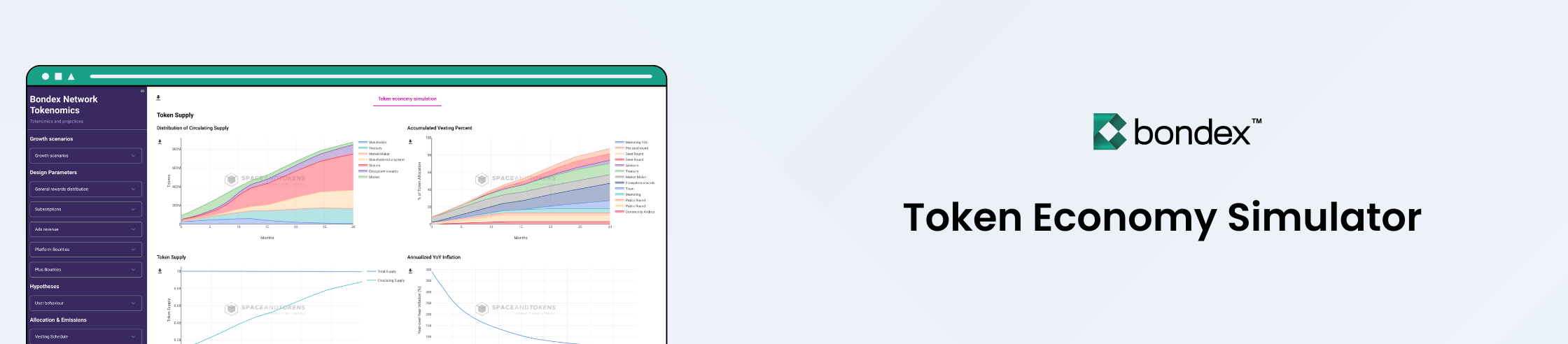


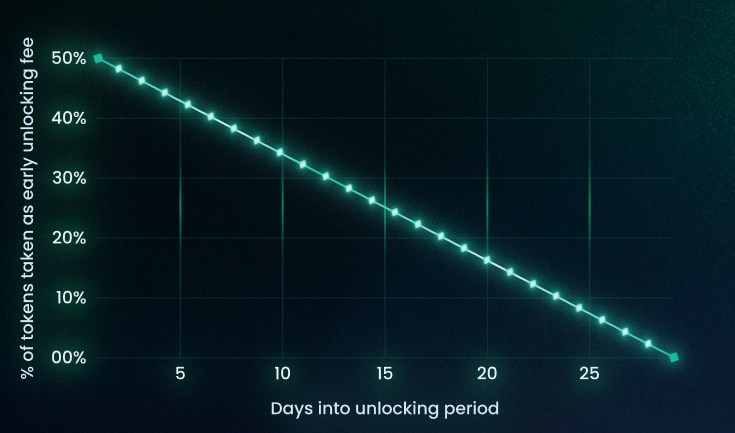

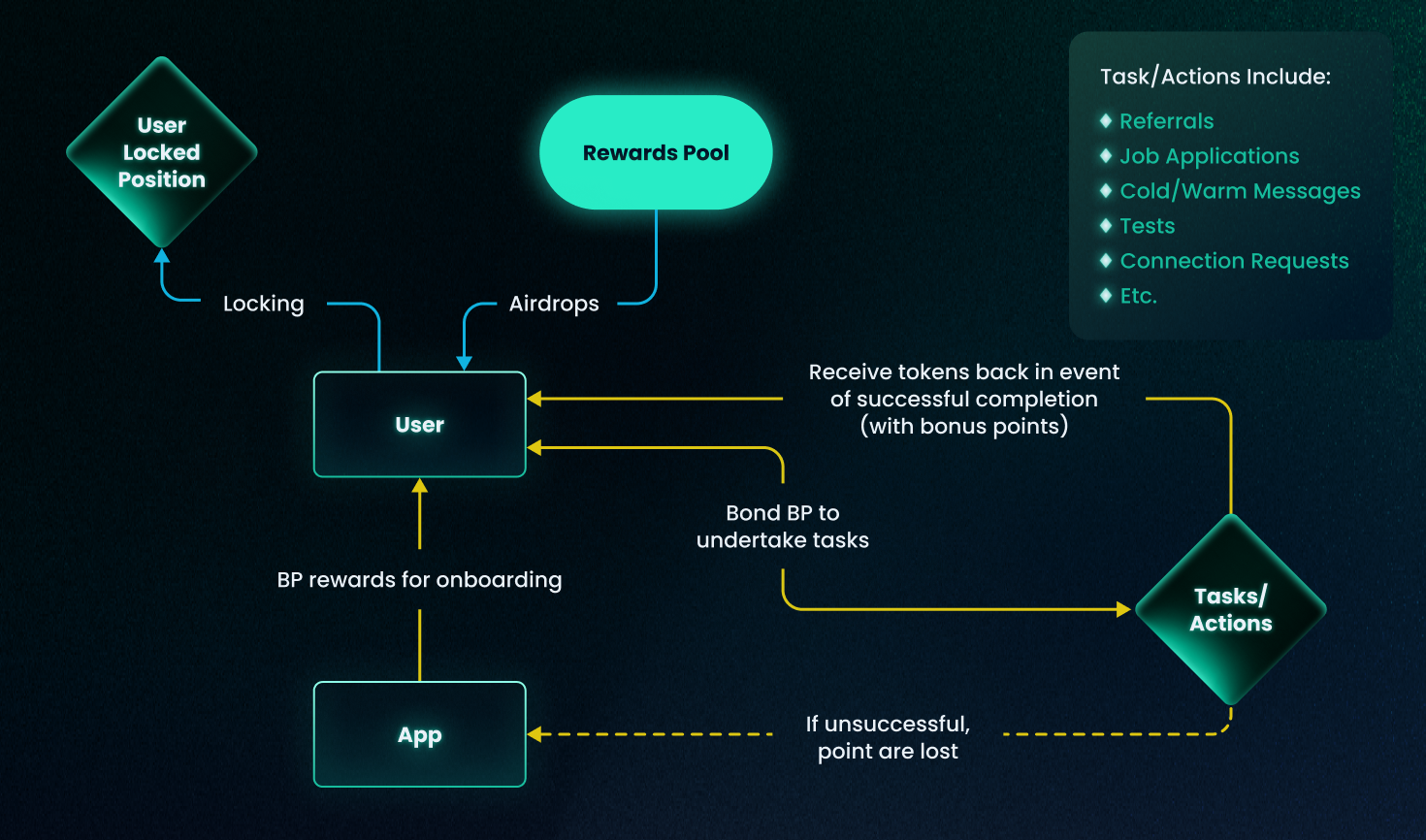


 **(25-64 points)**
* Achieving this status signifies that a user has completed multiple verifications across various categories, such as Identity, Professional, Blockchain & Crypto, and Social.
* **Elite**
**(25-64 points)**
* Achieving this status signifies that a user has completed multiple verifications across various categories, such as Identity, Professional, Blockchain & Crypto, and Social.
* **Elite**  **(65+ points)**
* Elite users have a fully verified identity and a comprehensive set of credentials, granting them the highest level of platform benefits and the most advantageous Activity Rates for earning Bond Points.
Achieving **Trusted** and **Elite** levels demonstrates a user's verified identity, as well as achievements and credentials across the other categories. These levels unlock enhanced benefits on the platform, including higher Activity Rates for earning Bond Points.
# Reputation Level Benefits
### **Why is the Reputation System Important?**
The Reputation score and level are visible on user profiles, reinforcing trust and credibility. As the platform evolves, users with high reputation levels will stand out as trusted participants in the Web3 talent network.
### **Benefits of Achieving Trusted and Elite Levels**
Achieving Trusted (25+ points) or Elite (65+ points) status within the Bondex network unlocks key benefits for users:
**Increased Activity Rate**\
Users at Trusted or Elite levels earn Bond Points at a higher hourly rate when they activate the Boost feature. This boost lasts for 24 hours, increasing earning potential for engaged users.
**Visibility & Social Recognition**\
Reputation levels are displayed on user profiles, providing social proof of trustworthiness, experience, and engagement. This visibility is critical as Bondex develops public profiles and social networking.
**Enhanced Platform Privileges**\
As the platform grows, high-reputation users may gain access to exclusive features, premium job listings, or early access to new features and products.
***
###
# Minting Your Bondex ID
Users can mint their Bondex ID once they achieve the **Trusted** or **Elite** reputation levels. For a limited time, this will be a **free mint**, allowing users to attest their Bondex ID and Reputation Score on-chain via the **Ethereum Attestation Service (EAS) on base**.
#### **How to Mint Your Bondex ID**
1. **Achieve Trusted or Elite Level**: Users must accumulate a minimum of 25 Reputation Points to become Trusted or 65+ points to become Elite.
2. **Initiate the Minting Process**: Once eligible, users will have an option to mint their Bondex ID within the Bondex app.
3. **On-Chain ID**: The Bondex ID and the current Reputation Score are attested on-chain using the Ethereum Attestation Service (EAS) on base, making it verifiable across the Bondex ecosystem.
#### **Updating Your Bondex ID**
If you complete additional verifications after minting, you can mint a **new Bondex ID** that reflects your updated Reputation Score. This ensures your on-chain credentials stay accurate and up-to-date.
#### **Benefits of a Minted Bondex ID**
* **Verifiable Identity**: dApps in the Bondex ecosystem can verify your on-chain Reputation Score and credentials.
* **Proof of Credibility**: Showcase your achievements, verifications, and trustworthiness across Web2 and Web3.
* **Portable Reputation**: Your on-chain Bondex ID can be recognized by other platforms and dApps in the future, increasing its utility.
**On Chain Bondex ID**
Schema: [BONDEX ID](https://base.easscan.org/schema/view/0xcbddc68392f790083c6f2e1f089489b13fad3fdfde9ccad0704e79671e0208c3)
# Reputation Score
### **How Reputation Points Are Earned**
Users can accumulate reputation points by completing specific verifications across the following categories - **Identity, Professional, Blockchain & Crypto and Social Verifications**. Each successful verification increases the user's reputation score, helping them achieve higher levels (Trusted, Elite) and unlocking additional platform benefits.
Once verified, each provider verification is written into an off-chain attestation linked to the user's primary wallet.
# Identity Verifications
Verifications that prove a user’s identity and confirm they are a real, unique individual.
* **Didit**: 15 Reputation points
* **Coinbase**: 15 Reputation points
* **Binance**: 15 Reputation points
* **Gitcoin Passport**: 10 Reputation points
# Didit
[Didit](https://didit.me/) is a leading identity verification provider that facilitates Know Your Customer (KYC) checks. It enables users to prove their identity by verifying official documents such as passports, driver's licenses, and proof of personhood.
With coverage in over 220+ countries and territories, Didit ensures a global standard for identity verification, allowing Bondex users to build a trusted on-chain identity and enhance their Reputation score.
Didit verifications are typically approved instantly. If your verification status changes to "In Review," it means manual approval by the Bondex team is required. Users can check the status later and tap "Verify" to refresh and update the progress of their identity verification.
### Verification Declined?
If your verification has been declined, please upload your documents again. When doing so, ensure the following:
* Your full name is clearly visible.
* Your date of birth is legible.
* The issue and expiration dates of the document are clear.
* Your photograph in the document is clearly visible.
* The images are sharp, well-lit, and not blurry or dark.
* Double-check that the document photo matches your uploaded photo. Verification may be declined if there’s a lack of similarity between the two.
Please ensure that the photo in the document is clear and not blurry, as the system requires a clear image for facial recognition to function properly. We recommend using a document with an updated, high-quality photo to avoid any issues with the verification process.
Make sure the documents meet these criteria to avoid further delays.
**Score:**
15 Reputation points
**Attestation:**
Schema: [BONDEX VERIFICATIONS](https://base.easscan.org/schema/view/0xf3ff6dd4a9dab34450af4e60df1eb41ca1e60fd719ce8645bbbed68aa84b489f)
Verification\_type: didit
Context: KYC Complete
# Coinbase
Complete your identity verification (KYC) and verify your Coinbase account.
Step 1: [**Verify Coinbase ID**](https://www.coinbase.com/onchain-verify) on any Bondex connected wallet.
Step 2: Ensure you have an active Coinbase account and mint your onchain attestation free on base.
Step 3: Tap 'Verify' to receive your verification on Bondex.
**Score:**
15 Reputation points
**Attestation:**
Schema: [BONDEX VERIFICATIONS](https://base.easscan.org/schema/view/0xf3ff6dd4a9dab34450af4e60df1eb41ca1e60fd719ce8645bbbed68aa84b489f)
Verification\_type: Coinbase
Context: Verified Account
# Binance
Verify by obtaining your Binance Account Bound Token (BABT) that proves you have completed identity verification.
**Step 1**: Get your [BABT](https://www.binance.com/en-GB/babt) through Binance and use your Bondex connected wallet.
Once verified, you should recieve a message on the Binance website like:
Your BAB token has been issued to \[your wallet address] on BNB Smart Chain
**Step 2**: Tap 'Verify' in the Bondex App to receive your verification. Ensure the same wallet that is connected to your Bondex Account holds your BABT token.
**Score:**
15 Reputation points
**Attestation:**
Schema: [BONDEX VERIFICATIONS](https://base.easscan.org/schema/view/0xf3ff6dd4a9dab34450af4e60df1eb41ca1e60fd719ce8645bbbed68aa84b489f)
Verification\_type: Binance
Context: BABT Verified
# Gitcoin Passport
Verify your Gitcoin Passport and earn this credential if your Humanity Score score is 15 or higher.
Step 1: Ensure the same wallet used on [Gitcoin Passport](https://passport.gitcoin.co/) is connected to your Bondex account
Step 2: Click 'Verify' to receive your verification on Bondex.
**Score:**
10 Reputation points
**Attestation:**
Schema: [BONDEX VERIFICATIONS](https://base.easscan.org/schema/view/0xf3ff6dd4a9dab34450af4e60df1eb41ca1e60fd719ce8645bbbed68aa84b489f)
Verification\_type: gitcoin\_passport
Context: Verified Passport
# Professional Verifications
Verifications that prove a user’s Verifications that highlight a user’s skills, work experience, and technical expertise.
* **Valid Resume**: 5 Reputation points
* **Github**: Up to 10 Reputation points
* **LinkedIn**: Up to 5 Reputation points
# Valid Resume
Upload a valid resume to your Bondex profile to increase your Reputation score.
Resume's should match your profile name, be written in English and include experience and education sections.
**Score:**
5 Reputation points
**Attestation:**
Schema: [BONDEX VERIFICATIONS](https://base.easscan.org/schema/view/0xf3ff6dd4a9dab34450af4e60df1eb41ca1e60fd719ce8645bbbed68aa84b489f)
Verification\_type: bdx\_resume
Context: Verified Resume
# Github
Connect your Github account through our Reclaim Verifier and receive Reputation points for qualifying verifications.
Our Github verification uses Reclaim Protocol, you can find more information [here](/bondex-id-and-reputation/bondex-id-and-reputation/reputation-score/reclaim-protocol)
**Score:**
Up to 10 Reputation points
* Verified Account (1 point)
* Github OG (2 points) - Account created before Jan 2016
* Github Contributor (4 points) - More than 500 contributions in the last year
* Github Respected (3 points) - More than 1,000 followers
**Attestation:**
Schema: [BONDEX VERIFICATIONS](https://base.easscan.org/schema/view/0xf3ff6dd4a9dab34450af4e60df1eb41ca1e60fd719ce8645bbbed68aa84b489f)
Verification\_type: github
Context:
Verified Account
Github OG
Github Contributor
Github Respected
# LinkedIn
Connect your Github account through our Reclaim Verifier and receive Reputation points for qualifying verifications.
Our LinkedIn verification uses Reclaim Protocol, you can find more information [here](/bondex-id-and-reputation/bondex-id-and-reputation/reputation-score/reclaim-protocol)
**Score:**
Up to 5 Reputation points
* Verified Account (1 point)
* LinkedIn Power Networker (2 points) - More than 500 connections
* LinkedIn Thought Leader (2 points) - More than 3,000 followers
**Attestation:**
Schema: [BONDEX VERIFICATIONS](https://base.easscan.org/schema/view/0xf3ff6dd4a9dab34450af4e60df1eb41ca1e60fd719ce8645bbbed68aa84b489f)
Verification\_type: linkedin
Context:
Verified Account
LinkedIn Power Networker
LinkedIn Thought Leader
# Blockchain & Crypto Verifications
Verifications that showcase a user’s activity and involvement within the crypto space.
* **Valid Resume**: 5 Reputation points
* **Github**: Up to 10 Reputation points
* **LinkedIn**: Up to 5 Reputation points
# Wallet Activity
Wallet activity will be aggregated across all your connected wallets.
**Score:**
Up to 13 Reputation points
* Crypto Enthusiast (3 points) - Completed over 100 transactions
* Digital Art Collector (3 points) - Collect over 30 NFTs
* Crypto OG (3 points) - First wallet transaction before Jan 2019
* Token Swapper (2 points) - Over 20 token swaps on DEXs and wallets
* Participation Bunny (2 points) - Earned 10 or more POAPs
**Attestation:**
Schema: [BONDEX VERIFICATIONS](https://base.easscan.org/schema/view/0xf3ff6dd4a9dab34450af4e60df1eb41ca1e60fd719ce8645bbbed68aa84b489f)
Verification\_type: wallet\_activity
Context:
Crypto Enthusiast
Digital Art Collector
Crypto OG
Token Swapper
Participation Bunny
# ENS
Hold an ENS linked to any of your connected wallets to receive this verification.
**Score:**
2 Reputation points
**Attestation:**
Schema: [BONDEX VERIFICATIONS](https://base.easscan.org/schema/view/0xf3ff6dd4a9dab34450af4e60df1eb41ca1e60fd719ce8645bbbed68aa84b489f)
Verification\_type: ens
Context: Verified ENS holder
# Social Verifications
Verifications that Verifications that reflect the user’s online social presence and influence.
* **X**: Up to 11 Reputation points
* **Discord**: 3 Reputation points
* **Telegram**: 3 Reputation points
* **Farcaster**: Up to 6 Reputation points
# X (Twitter)
Connect your X account through our Reclaim Verifier and receive Reputation points for qualifying verifications.
Our X verification uses Reclaim Protocol, you can find more information [here](/bondex-id-and-reputation/bondex-id-and-reputation/reputation-score/reclaim-protocol)
**Score:**
Up to 11 Reputation points
* Verified X Account (1 points)
* X OG (2 points) - Account created before Jan 2016
* X Rising Voice (2 points) - Over 1,000 followers
* X Creator (3 points) - Over 10,000 followers
* X Influencer (3 points) - Over 50,000 followers
**Attestation:**
Schema: [BONDEX VERIFICATIONS](https://base.easscan.org/schema/view/0xf3ff6dd4a9dab34450af4e60df1eb41ca1e60fd719ce8645bbbed68aa84b489f)
Verification\_type: twitter
Context:
Verified Account
X OG
X Rising Voice
X Creator
X Influencer
# Discord
Connect your Discord to receive this verification.
**Score:**
3 Reputation points
**Attestation:**
Schema: [BONDEX VERIFICATIONS](https://base.easscan.org/schema/view/0xf3ff6dd4a9dab34450af4e60df1eb41ca1e60fd719ce8645bbbed68aa84b489f)
Verification\_type: discord
Context: Verified Account
# Telegram
Connect your Telegram to receive this verification.
**Score:**
3 Reputation points
**Attestation:**
Schema: [BONDEX VERIFICATIONS](https://base.easscan.org/schema/view/0xf3ff6dd4a9dab34450af4e60df1eb41ca1e60fd719ce8645bbbed68aa84b489f)
Verification\_type: telegram
Context: Verified Account
# Farcaster
Connect your Farcaster to receive Reputation points for qualifying verifications.
**Score:**
Up to 6 Reputation points
* Verified Account (3 points) - Connected Farcaster Account
* Farcaster OG (3 points) - FID below 50,000
**Attestation:**
Schema: [BONDEX VERIFICATIONS](https://base.easscan.org/schema/view/0xf3ff6dd4a9dab34450af4e60df1eb41ca1e60fd719ce8645bbbed68aa84b489f)
Verification\_type: farcaster
Context:
Verified Account
Farcaster OG
# Reclaim Protocol
At Bondex, we leverage **Reclaim Protocol** to provide a secure, seamless, and private way for users to verify credentials from platforms like X (formerly Twitter), LinkedIn, and GitHub. These verifications contribute to your **Reputation score** on Bondex without compromising your privacy or security.
**How It Works**
Reclaim Protocol uses **zero-knowledge proof technology** to verify your credentials from these platforms. Here's what makes it secure and user-friendly:
* **Privacy First**: Neither Reclaim nor Bondex store your login details. Only the specific verification data required to update your Reputation score is securely shared.
* **Secure Process**: When verifying a provider, a secure window opens for you to log in. Reclaim automatically navigates and retrieves the necessary credentials using **client-side digital signatures**. This ensures your data remains private and secure throughout the process.
* **Effortless Experience**: The process is quick and seamless, integrating smoothly into the Bondex platform while maintaining the highest security standards.
By utilizing Reclaim Protocol, Bondex ensures that your verifications are not only secure but also aligned with our mission to create a trusted and transparent Web3 talent network.
{% embed url="
**(65+ points)**
* Elite users have a fully verified identity and a comprehensive set of credentials, granting them the highest level of platform benefits and the most advantageous Activity Rates for earning Bond Points.
Achieving **Trusted** and **Elite** levels demonstrates a user's verified identity, as well as achievements and credentials across the other categories. These levels unlock enhanced benefits on the platform, including higher Activity Rates for earning Bond Points.
# Reputation Level Benefits
### **Why is the Reputation System Important?**
The Reputation score and level are visible on user profiles, reinforcing trust and credibility. As the platform evolves, users with high reputation levels will stand out as trusted participants in the Web3 talent network.
### **Benefits of Achieving Trusted and Elite Levels**
Achieving Trusted (25+ points) or Elite (65+ points) status within the Bondex network unlocks key benefits for users:
**Increased Activity Rate**\
Users at Trusted or Elite levels earn Bond Points at a higher hourly rate when they activate the Boost feature. This boost lasts for 24 hours, increasing earning potential for engaged users.
**Visibility & Social Recognition**\
Reputation levels are displayed on user profiles, providing social proof of trustworthiness, experience, and engagement. This visibility is critical as Bondex develops public profiles and social networking.
**Enhanced Platform Privileges**\
As the platform grows, high-reputation users may gain access to exclusive features, premium job listings, or early access to new features and products.
***
###
# Minting Your Bondex ID
Users can mint their Bondex ID once they achieve the **Trusted** or **Elite** reputation levels. For a limited time, this will be a **free mint**, allowing users to attest their Bondex ID and Reputation Score on-chain via the **Ethereum Attestation Service (EAS) on base**.
#### **How to Mint Your Bondex ID**
1. **Achieve Trusted or Elite Level**: Users must accumulate a minimum of 25 Reputation Points to become Trusted or 65+ points to become Elite.
2. **Initiate the Minting Process**: Once eligible, users will have an option to mint their Bondex ID within the Bondex app.
3. **On-Chain ID**: The Bondex ID and the current Reputation Score are attested on-chain using the Ethereum Attestation Service (EAS) on base, making it verifiable across the Bondex ecosystem.
#### **Updating Your Bondex ID**
If you complete additional verifications after minting, you can mint a **new Bondex ID** that reflects your updated Reputation Score. This ensures your on-chain credentials stay accurate and up-to-date.
#### **Benefits of a Minted Bondex ID**
* **Verifiable Identity**: dApps in the Bondex ecosystem can verify your on-chain Reputation Score and credentials.
* **Proof of Credibility**: Showcase your achievements, verifications, and trustworthiness across Web2 and Web3.
* **Portable Reputation**: Your on-chain Bondex ID can be recognized by other platforms and dApps in the future, increasing its utility.
**On Chain Bondex ID**
Schema: [BONDEX ID](https://base.easscan.org/schema/view/0xcbddc68392f790083c6f2e1f089489b13fad3fdfde9ccad0704e79671e0208c3)
# Reputation Score
### **How Reputation Points Are Earned**
Users can accumulate reputation points by completing specific verifications across the following categories - **Identity, Professional, Blockchain & Crypto and Social Verifications**. Each successful verification increases the user's reputation score, helping them achieve higher levels (Trusted, Elite) and unlocking additional platform benefits.
Once verified, each provider verification is written into an off-chain attestation linked to the user's primary wallet.
# Identity Verifications
Verifications that prove a user’s identity and confirm they are a real, unique individual.
* **Didit**: 15 Reputation points
* **Coinbase**: 15 Reputation points
* **Binance**: 15 Reputation points
* **Gitcoin Passport**: 10 Reputation points
# Didit
[Didit](https://didit.me/) is a leading identity verification provider that facilitates Know Your Customer (KYC) checks. It enables users to prove their identity by verifying official documents such as passports, driver's licenses, and proof of personhood.
With coverage in over 220+ countries and territories, Didit ensures a global standard for identity verification, allowing Bondex users to build a trusted on-chain identity and enhance their Reputation score.
Didit verifications are typically approved instantly. If your verification status changes to "In Review," it means manual approval by the Bondex team is required. Users can check the status later and tap "Verify" to refresh and update the progress of their identity verification.
### Verification Declined?
If your verification has been declined, please upload your documents again. When doing so, ensure the following:
* Your full name is clearly visible.
* Your date of birth is legible.
* The issue and expiration dates of the document are clear.
* Your photograph in the document is clearly visible.
* The images are sharp, well-lit, and not blurry or dark.
* Double-check that the document photo matches your uploaded photo. Verification may be declined if there’s a lack of similarity between the two.
Please ensure that the photo in the document is clear and not blurry, as the system requires a clear image for facial recognition to function properly. We recommend using a document with an updated, high-quality photo to avoid any issues with the verification process.
Make sure the documents meet these criteria to avoid further delays.
**Score:**
15 Reputation points
**Attestation:**
Schema: [BONDEX VERIFICATIONS](https://base.easscan.org/schema/view/0xf3ff6dd4a9dab34450af4e60df1eb41ca1e60fd719ce8645bbbed68aa84b489f)
Verification\_type: didit
Context: KYC Complete
# Coinbase
Complete your identity verification (KYC) and verify your Coinbase account.
Step 1: [**Verify Coinbase ID**](https://www.coinbase.com/onchain-verify) on any Bondex connected wallet.
Step 2: Ensure you have an active Coinbase account and mint your onchain attestation free on base.
Step 3: Tap 'Verify' to receive your verification on Bondex.
**Score:**
15 Reputation points
**Attestation:**
Schema: [BONDEX VERIFICATIONS](https://base.easscan.org/schema/view/0xf3ff6dd4a9dab34450af4e60df1eb41ca1e60fd719ce8645bbbed68aa84b489f)
Verification\_type: Coinbase
Context: Verified Account
# Binance
Verify by obtaining your Binance Account Bound Token (BABT) that proves you have completed identity verification.
**Step 1**: Get your [BABT](https://www.binance.com/en-GB/babt) through Binance and use your Bondex connected wallet.
Once verified, you should recieve a message on the Binance website like:
Your BAB token has been issued to \[your wallet address] on BNB Smart Chain
**Step 2**: Tap 'Verify' in the Bondex App to receive your verification. Ensure the same wallet that is connected to your Bondex Account holds your BABT token.
**Score:**
15 Reputation points
**Attestation:**
Schema: [BONDEX VERIFICATIONS](https://base.easscan.org/schema/view/0xf3ff6dd4a9dab34450af4e60df1eb41ca1e60fd719ce8645bbbed68aa84b489f)
Verification\_type: Binance
Context: BABT Verified
# Gitcoin Passport
Verify your Gitcoin Passport and earn this credential if your Humanity Score score is 15 or higher.
Step 1: Ensure the same wallet used on [Gitcoin Passport](https://passport.gitcoin.co/) is connected to your Bondex account
Step 2: Click 'Verify' to receive your verification on Bondex.
**Score:**
10 Reputation points
**Attestation:**
Schema: [BONDEX VERIFICATIONS](https://base.easscan.org/schema/view/0xf3ff6dd4a9dab34450af4e60df1eb41ca1e60fd719ce8645bbbed68aa84b489f)
Verification\_type: gitcoin\_passport
Context: Verified Passport
# Professional Verifications
Verifications that prove a user’s Verifications that highlight a user’s skills, work experience, and technical expertise.
* **Valid Resume**: 5 Reputation points
* **Github**: Up to 10 Reputation points
* **LinkedIn**: Up to 5 Reputation points
# Valid Resume
Upload a valid resume to your Bondex profile to increase your Reputation score.
Resume's should match your profile name, be written in English and include experience and education sections.
**Score:**
5 Reputation points
**Attestation:**
Schema: [BONDEX VERIFICATIONS](https://base.easscan.org/schema/view/0xf3ff6dd4a9dab34450af4e60df1eb41ca1e60fd719ce8645bbbed68aa84b489f)
Verification\_type: bdx\_resume
Context: Verified Resume
# Github
Connect your Github account through our Reclaim Verifier and receive Reputation points for qualifying verifications.
Our Github verification uses Reclaim Protocol, you can find more information [here](/bondex-id-and-reputation/bondex-id-and-reputation/reputation-score/reclaim-protocol)
**Score:**
Up to 10 Reputation points
* Verified Account (1 point)
* Github OG (2 points) - Account created before Jan 2016
* Github Contributor (4 points) - More than 500 contributions in the last year
* Github Respected (3 points) - More than 1,000 followers
**Attestation:**
Schema: [BONDEX VERIFICATIONS](https://base.easscan.org/schema/view/0xf3ff6dd4a9dab34450af4e60df1eb41ca1e60fd719ce8645bbbed68aa84b489f)
Verification\_type: github
Context:
Verified Account
Github OG
Github Contributor
Github Respected
# LinkedIn
Connect your Github account through our Reclaim Verifier and receive Reputation points for qualifying verifications.
Our LinkedIn verification uses Reclaim Protocol, you can find more information [here](/bondex-id-and-reputation/bondex-id-and-reputation/reputation-score/reclaim-protocol)
**Score:**
Up to 5 Reputation points
* Verified Account (1 point)
* LinkedIn Power Networker (2 points) - More than 500 connections
* LinkedIn Thought Leader (2 points) - More than 3,000 followers
**Attestation:**
Schema: [BONDEX VERIFICATIONS](https://base.easscan.org/schema/view/0xf3ff6dd4a9dab34450af4e60df1eb41ca1e60fd719ce8645bbbed68aa84b489f)
Verification\_type: linkedin
Context:
Verified Account
LinkedIn Power Networker
LinkedIn Thought Leader
# Blockchain & Crypto Verifications
Verifications that showcase a user’s activity and involvement within the crypto space.
* **Valid Resume**: 5 Reputation points
* **Github**: Up to 10 Reputation points
* **LinkedIn**: Up to 5 Reputation points
# Wallet Activity
Wallet activity will be aggregated across all your connected wallets.
**Score:**
Up to 13 Reputation points
* Crypto Enthusiast (3 points) - Completed over 100 transactions
* Digital Art Collector (3 points) - Collect over 30 NFTs
* Crypto OG (3 points) - First wallet transaction before Jan 2019
* Token Swapper (2 points) - Over 20 token swaps on DEXs and wallets
* Participation Bunny (2 points) - Earned 10 or more POAPs
**Attestation:**
Schema: [BONDEX VERIFICATIONS](https://base.easscan.org/schema/view/0xf3ff6dd4a9dab34450af4e60df1eb41ca1e60fd719ce8645bbbed68aa84b489f)
Verification\_type: wallet\_activity
Context:
Crypto Enthusiast
Digital Art Collector
Crypto OG
Token Swapper
Participation Bunny
# ENS
Hold an ENS linked to any of your connected wallets to receive this verification.
**Score:**
2 Reputation points
**Attestation:**
Schema: [BONDEX VERIFICATIONS](https://base.easscan.org/schema/view/0xf3ff6dd4a9dab34450af4e60df1eb41ca1e60fd719ce8645bbbed68aa84b489f)
Verification\_type: ens
Context: Verified ENS holder
# Social Verifications
Verifications that Verifications that reflect the user’s online social presence and influence.
* **X**: Up to 11 Reputation points
* **Discord**: 3 Reputation points
* **Telegram**: 3 Reputation points
* **Farcaster**: Up to 6 Reputation points
# X (Twitter)
Connect your X account through our Reclaim Verifier and receive Reputation points for qualifying verifications.
Our X verification uses Reclaim Protocol, you can find more information [here](/bondex-id-and-reputation/bondex-id-and-reputation/reputation-score/reclaim-protocol)
**Score:**
Up to 11 Reputation points
* Verified X Account (1 points)
* X OG (2 points) - Account created before Jan 2016
* X Rising Voice (2 points) - Over 1,000 followers
* X Creator (3 points) - Over 10,000 followers
* X Influencer (3 points) - Over 50,000 followers
**Attestation:**
Schema: [BONDEX VERIFICATIONS](https://base.easscan.org/schema/view/0xf3ff6dd4a9dab34450af4e60df1eb41ca1e60fd719ce8645bbbed68aa84b489f)
Verification\_type: twitter
Context:
Verified Account
X OG
X Rising Voice
X Creator
X Influencer
# Discord
Connect your Discord to receive this verification.
**Score:**
3 Reputation points
**Attestation:**
Schema: [BONDEX VERIFICATIONS](https://base.easscan.org/schema/view/0xf3ff6dd4a9dab34450af4e60df1eb41ca1e60fd719ce8645bbbed68aa84b489f)
Verification\_type: discord
Context: Verified Account
# Telegram
Connect your Telegram to receive this verification.
**Score:**
3 Reputation points
**Attestation:**
Schema: [BONDEX VERIFICATIONS](https://base.easscan.org/schema/view/0xf3ff6dd4a9dab34450af4e60df1eb41ca1e60fd719ce8645bbbed68aa84b489f)
Verification\_type: telegram
Context: Verified Account
# Farcaster
Connect your Farcaster to receive Reputation points for qualifying verifications.
**Score:**
Up to 6 Reputation points
* Verified Account (3 points) - Connected Farcaster Account
* Farcaster OG (3 points) - FID below 50,000
**Attestation:**
Schema: [BONDEX VERIFICATIONS](https://base.easscan.org/schema/view/0xf3ff6dd4a9dab34450af4e60df1eb41ca1e60fd719ce8645bbbed68aa84b489f)
Verification\_type: farcaster
Context:
Verified Account
Farcaster OG
# Reclaim Protocol
At Bondex, we leverage **Reclaim Protocol** to provide a secure, seamless, and private way for users to verify credentials from platforms like X (formerly Twitter), LinkedIn, and GitHub. These verifications contribute to your **Reputation score** on Bondex without compromising your privacy or security.
**How It Works**
Reclaim Protocol uses **zero-knowledge proof technology** to verify your credentials from these platforms. Here's what makes it secure and user-friendly:
* **Privacy First**: Neither Reclaim nor Bondex store your login details. Only the specific verification data required to update your Reputation score is securely shared.
* **Secure Process**: When verifying a provider, a secure window opens for you to log in. Reclaim automatically navigates and retrieves the necessary credentials using **client-side digital signatures**. This ensures your data remains private and secure throughout the process.
* **Effortless Experience**: The process is quick and seamless, integrating smoothly into the Bondex platform while maintaining the highest security standards.
By utilizing Reclaim Protocol, Bondex ensures that your verifications are not only secure but also aligned with our mission to create a trusted and transparent Web3 talent network.
{% embed url="